Kulshan Studios

Boutique Synth Preset & MIDI Packs for Producers, Keyboardists & Composers

Sample & MIDI packs, tutorials, and presets for analog, virtual analog, and software synthesizers

Filtering by Tag: Iridium soundsets

Top 10 Hardware Synths For Psytrance Producers

Psytrance producers! Been flicking through Serum and Diva presets, and just not landing on anything that sticks? Been feeling a pull towards a more classic vibe, or a more organic songwriting workflow? Want some more characterful vibes for your next zenonesque bush doof tune? Take a gander at this list


Access Virus TI2
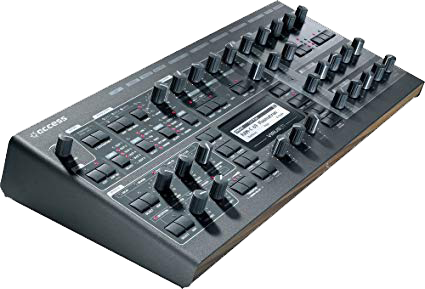
Let’s be honest. You all knew this was gonna be on the list. The Virus series has been the gold standard for Psytrance for 20+ years, and the TI2 the crown jewel of them all. Deep mod matrix, HyperSaws, analog waveforms, wavetables, graintables, and tons of FX and extra envelopes make it god-tier for Psytrance of all types. Shame the DSP chips are out of production and the synth has a finite lifespan now. But at least it lives on in the OsTIrus plugin by The Usual Suspects. Nothing beats the hands on tactile feel of using the real hardware though. If you can get your hands on a physical unit, it is fun and exciting to work with for everything from airy morning psy down to the dankest zenonesque.

Polyphony: 90+ voices

Multitimbral: 16 parts

Oscillators: 3 osc + subosc + noise, FM, Sync

Waveforms: Sine / pulse / saw / hypersaw / wavetable / granular / formant

Filter: dual LP/HP/BP/BR with envelopes and addtional multi-pole analog emulations (includes Minimoog 4-pole emulation)

LFO: 3 LFOs, multiple options plus mod matrix 18 slots

Envelope: Amp / Filter / 'LFO as envelope' option

Sequencer: none onboard

Arpeggiator: Up / Down / Random / Chord / Multiple additions, editable in software to any variation

Effects: Reverbs, Delays, EQs with Q and freq control, Tape Delays, Distortions (multiple), Phasers, Flangers, Chorus, Analog EQs, Vocoder.

Memory: 128 patches in each of 30 banks plus USB storage / Librarian with additional free patchbanks provided regularly by Access

Control: MIDI, USB, 16-part multitimbral in Multi or sequencer modes


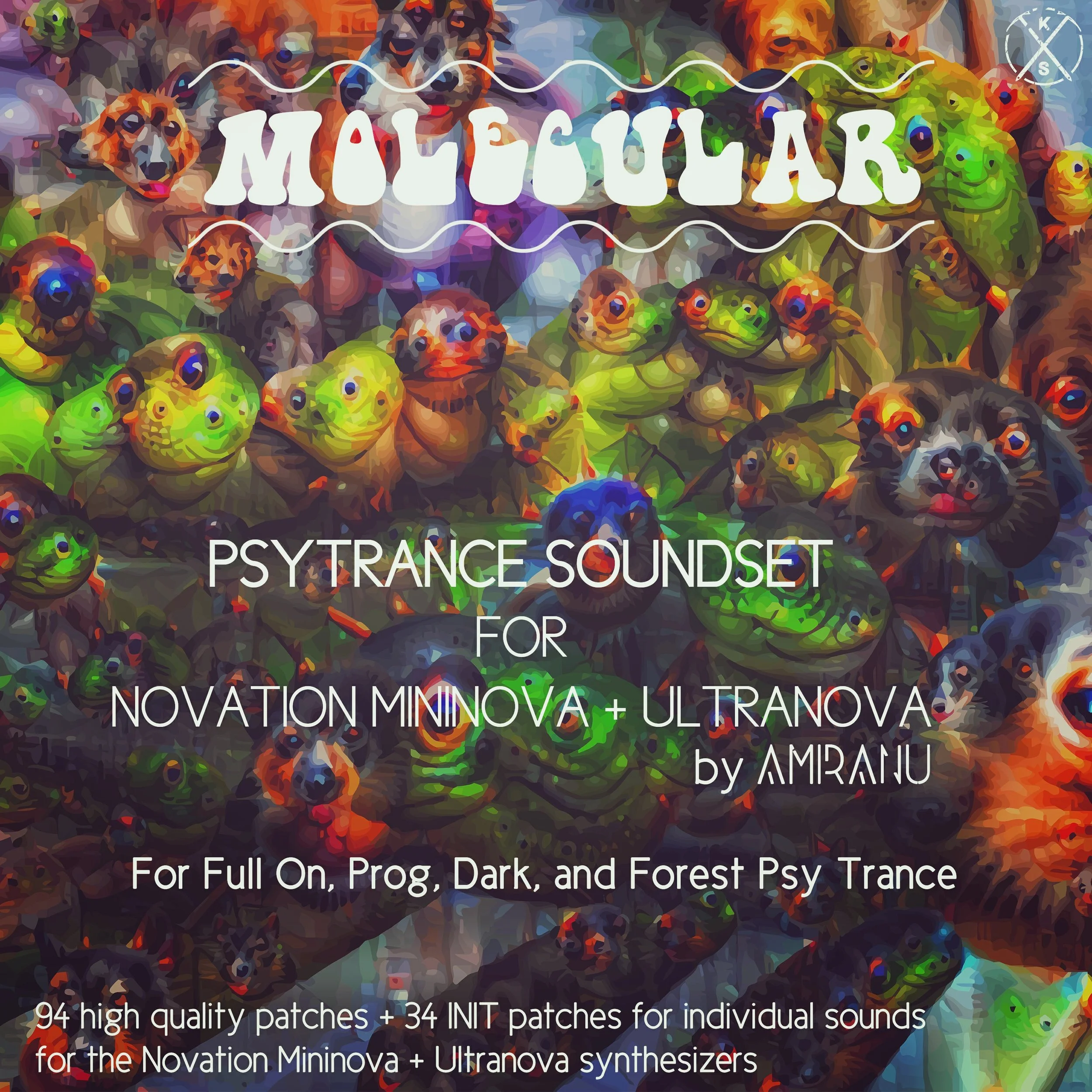
Novation Mininova
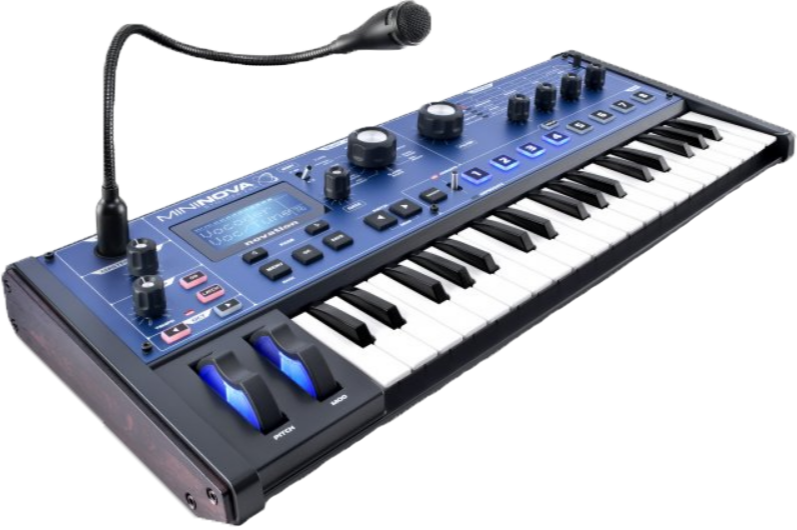
If you want the power of a Virus, but at a fraction of the cost, the Mininova is your best bet. It also has a deep mod matrix, and each oscillator in any mode can be turned into a Super-style waveform via the Density parameters, which is super nice for crazy evolving pads and atmospheric textures. The VSync is also fun for approximating FM type sounds. The mod matrix and FX give this synth some serious power for creating trippy evolving textures and blurbly noises and gritty stabs, which make for some very nice chunky prog and forest psy.

Polyphony - Up to 18-note polyphony (dynamic voicing)

Multitimbral - Mono-Timbral (1 Part)

Synthesis Method - Based on Supernova II
Waveforms include: Square, sine, tri, sawtooth, pulse, 9 x saw:pulse combinations. 20 x digital waveforms. 36 x wavetables

Effects- Distortion - up to 2 instances. Compressor - up to 2 instances. Chorus/Phase - up to 4 instances. Delay - up to 2 instances. Reverb - up to 2 instances. Gator. EQ. 12 band vocoder.

Arpeggiator - 33 patterns. Chord function - lock up to 10 notes

Patch storage up to 512 on hardware (ships with 300 factory patches)

Controllers - 8 x touch sensitive encoders. 1 x large smooth encoder (with back-lit filter lock buttons). 1 x large patch select/speed dial encoder. 2 x volume & monitor mix dials. 39 x LED lit/indicated buttons. 1 x Pitch wheel (LED lit). 1 x Modulation wheel (LED lit)

37-note keyboard with velocity and aftertouch

Connections - XLR dynamic mic input. 2 x ¼" jack inputs. 2 x ¼" jack outputs. 2 x ¼" jack aux outputs. 1 x ¼" jack headphone output. Expression pedal on ¼" jack input. Sustain pedal on ¼" jack input. MIDI in/out/thru. 12 volt power input. USB port (can be powered via USB). Kensington Lock port


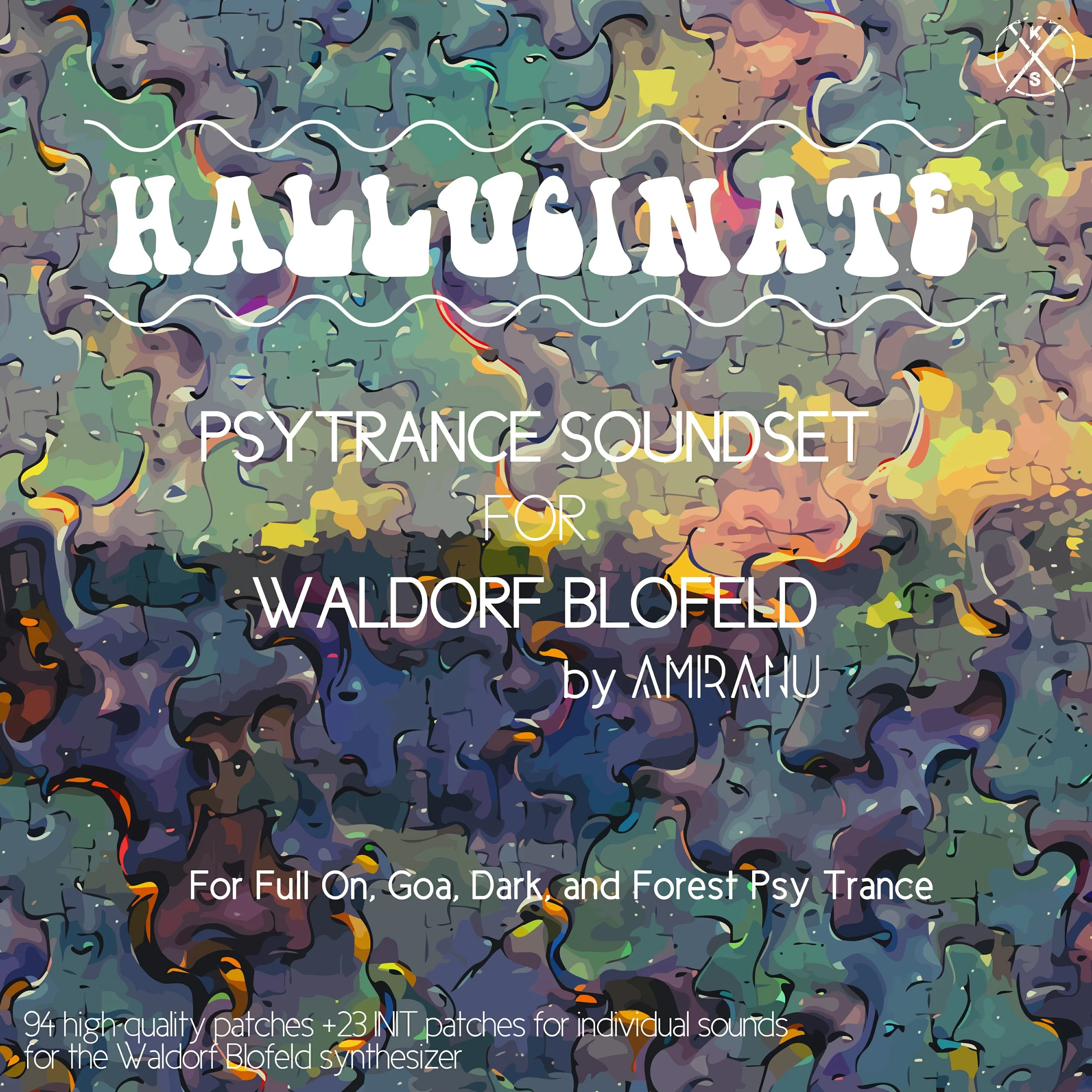
Waldorf Blofeld
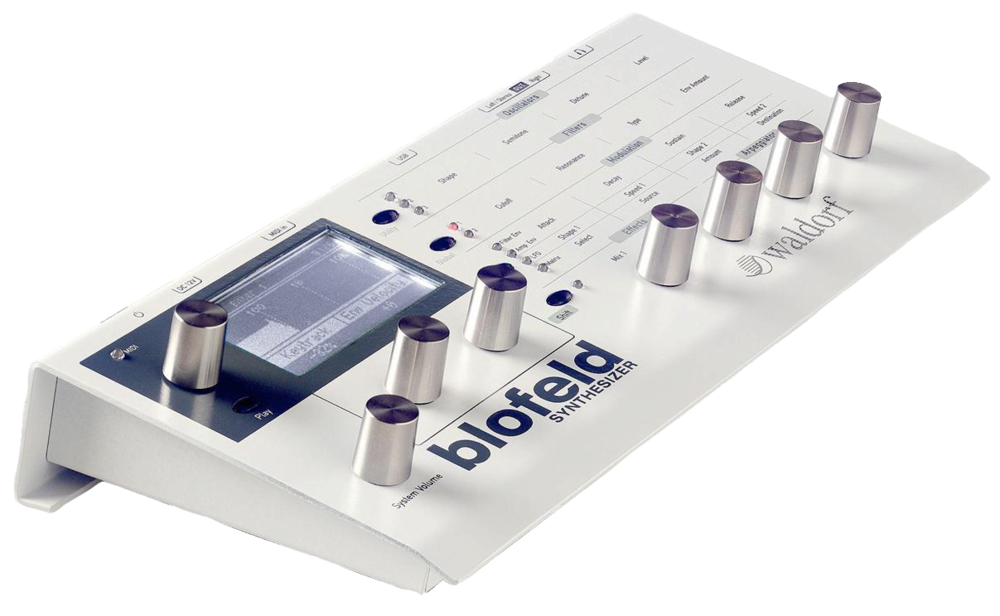
Definitely an underrated Psytrance powerhouse. This one has features few other synths have, since alongside the usual analog waveforms and wavetables, you also get some exotic features like Comb Filters and an even deeper mod matrix than the Mininova. The ability to manually brighten up individual oscillators via the Brilliance setting also allows this synth to cut through a mix with a precision even the Virus can’t match by default. The Blofeld is definitely a good runner-up if you can’t afford a Virus, but be prepared to invest in a dedicated reverb plugin/ pedal/ rack unit if you want to exploit this synth to its fullest (the onboard reverb is one of the weakest points of the synth). And it even comes in a VST and AU plugin version for Windows and PC, if you can’t spring for a physical unit.

Polyphony: 25 voices maximum (Poly, Mono, Dual or Unison modes)

Multitimbral: 16 parts

Sampler: 44.1kHz mono with 60 Mb RAM

Oscillators: 3 oscillators per voice (128' to 1/2') plus noise, frequency modulation, ring modulation

Waveforms: All Q Oscillator models: sine, saw, triangle, square with PWM; 68 digital 16-bit wavetables from Microwave II/XT/XTK

LFO: 3 LFOs per voice with square, sine, saw, triangle, S&H, random with delay and fade in/out

Modulation: Modulation Matrix with 16 Slots, freely programmable

Filter: 2 independent Multi Mode Filters per voice: Low pass, High pass, Band pass, Notch, Comb; 12 or 24 dB/oct modes

Envelope: 4 Envelopes per voice, ADSR, AD1S1D2S2R, One Shot, Loopable

Effects: 2 Effect units with Chorus, Flanger, Phaser, Overdrive, Decimator, Delay, Reverb

Vocoder: None

Sequencer: None

Arpeggiator: Programmable, 16 steps, Up, Down, Alt Up, Alt Down, Random

Memory: 1024 sounds, 128 multi sets

Control: MIDI IN (plus OUT on Keyboard), USB


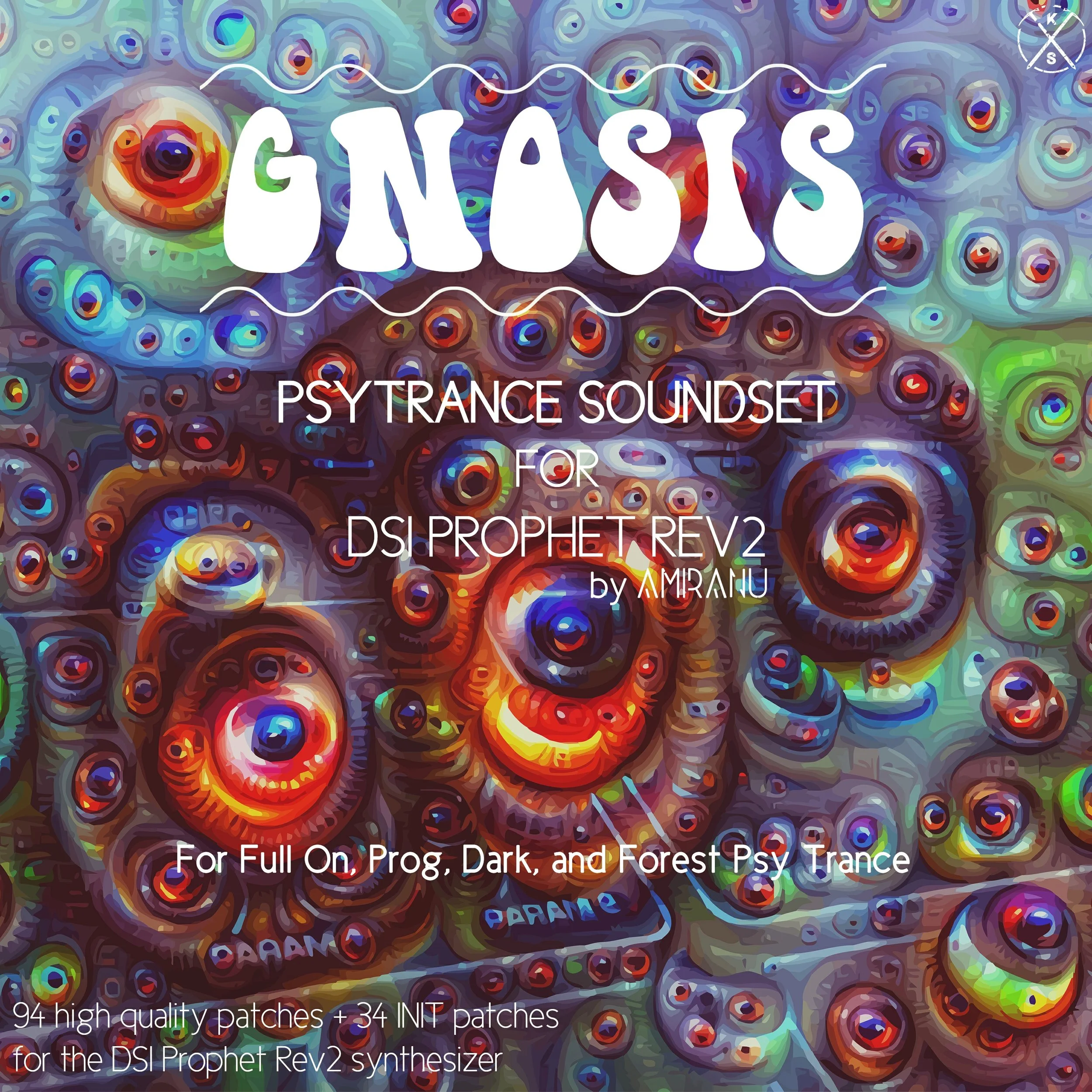
SEQUENTIAL PROPHET REV2
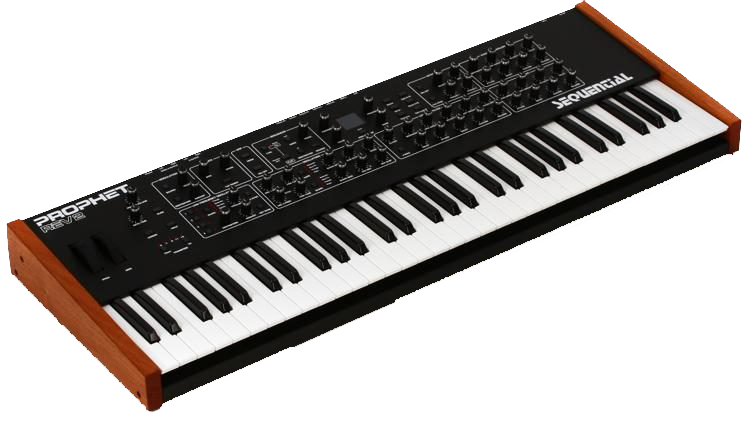
The Rev2 is where you wanna go if you want a polyphonic analog without shelling out a fortune for a Moog One, or rolling the dice on an Andromeda A6, or losing stereo panning on the other Prophets (or losing significant polyphony using something like a Fourm). This is more or less the Virus of modern analogs, with a nice deep mod matrix, bitimbrality, and mostly solid FX (the reverb and phaser leave something to be desired, and the Distortion sounds great, but increases the noise floor of the outputs, which is really strange). On the 4-pole mode it does warm organic evolving plucks and pads and leads super nicely, and in Unison Mode, if you pick the right number of voices (odd number voices are safest), you can make bass pads that you can spread wide or pull to mono, and when summed to mono/ pull the lows down to mono for mono-stereo compatibility, you won’t lose the whole sound to phase cancellation. And despite the Rev2’s reputation for sounding “cold” or “thin” compared to other analogs, it works really nicely as a bass synth, doing tight and deep prog and forest psy basses really nicely. And if you scoop the 3000 Hz range a little, it’s also really nice for warm organic pad sounds. If you plan to use it for pads, do budget for the 16 voice version/ the voice expansion card upgrade, as it is a must for pads on this synth.

Polyphony - 8 or 16 voice polyphony (8 voice version is expandable to 16 with installation of additional voice card)

Oscillators - 2 digitally controlled analog oscillators (DCOs) per voice (plus sub octave on oscillator 1) with selectable sawtooth, triangle, saw/triangle mix, and pulse waves (with pulse-width modulation). Glide (portamento): separate rates per oscillator. White noise generator. Analog VCAs. Hard sync

Filters - 1 analog Curtis low-pass filter per voice, selectable 2- and 4-pole operation (self-resonating in 4-pole mode)

Envelopes - 3 envelope generators: filter, VCA, and assignable (four-stage ADSR + delay); Envelope 3 can loop.

Sequencer - Polyphonic step sequencer with up to 64 steps (6 notes per step), and ties and rests. Separate 16 x 4 gated step sequencer. Each layer can have a separate sequence.

LFOs - 4 LFO’s with key sync per LFO

Modulation - 8-slot modulation matrix, 22 sources, 53 destinations, 5 additional dedicated sources: mod wheel, pressure, velocity, breath controller, footswitch

Arpeggiator - Programmable arpeggiator with up, down, up+down, random, assign modes. Selectable note value: 16th note, 8th note triplet, 8th note, dotted 8th note, quarter note. One, two, or three octave range. Re-latching arpeggiation. Note repeat

Controls - 5-octave keyboard with semi-weighted action, velocity, and aftertouch. 55 knobs and 35 buttons enable deep and comprehensive editing with little to no menu diving.. Spring-loaded pitch wheel and assignable mod wheel

Memory - 512 Factory Programs (4 banks of 128) and 512 fully editable User Programs with 2 layers (2 separate sounds) in each Program

In/Out - MIDI In, Out, Thru. Main stereo audio output: 1/4″ unbalanced. Output B stereo audio output: 1/4″ unbalanced. Sustain pedal input: accepts normally on or normally off momentary footswitch.

Pedal/CV input - responds to expression pedals or control voltages ranging from 0 to 5 VDC (protected against higher or negative voltages). Headphone output: 1/4″ stereo phone jack.

Amiranu used the Prophet Rev2 extensively in this track, for all the bass sounds, and the big pluck


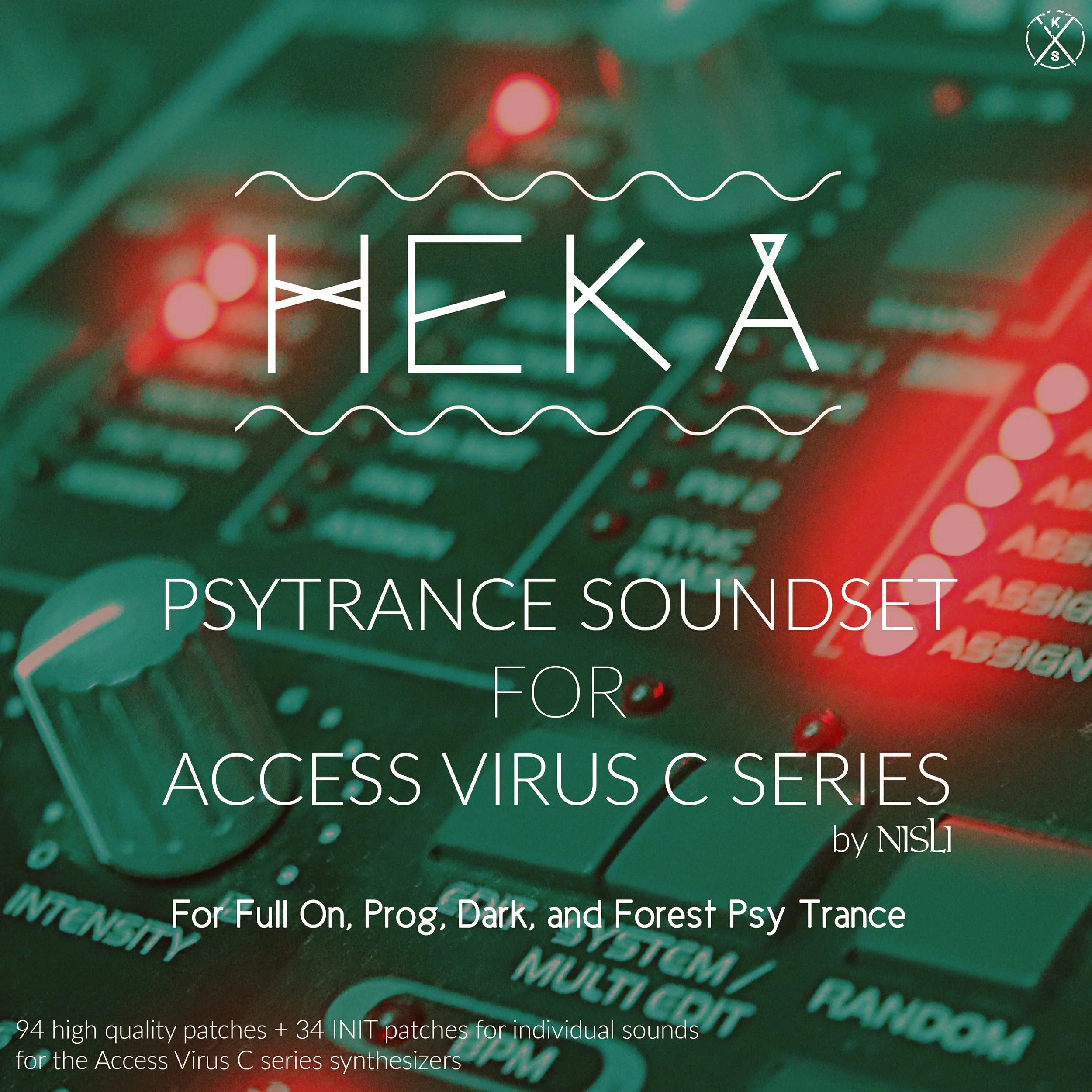
ACCESS VIRUS C
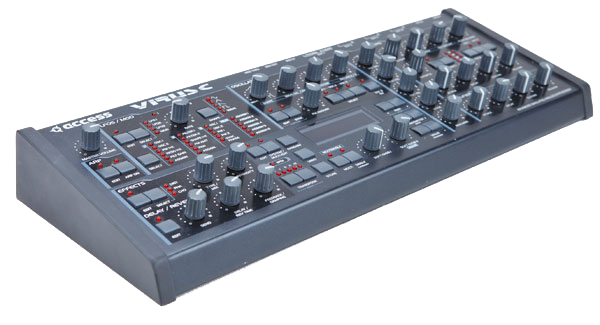
No Psytrance hardware synth list is complete without a Virus C on it, eh. Before the TI line came along, the C was the de facto standard for Full On Psytrance, and was present in many studios back in the day. It still has a nice punchy sound, and even though the TI and TI2 later surpassed it, it still offers almost the same sound, and many of the same features as the TI, and if you can live without wavetables, per-oscillator HyperSaws, and rotary-speaker and cabinet amp model FX, the C is a rock-solid choice. You can even Try Before You Buy vis a vis the Osirus plugin from The Usual Suspects, so if you like the idea of a C but wanna hear how it sounds before committing a bunch of money to a physical unit, you can use the plugin as a testing ground.

Polyphony: 32 voices

Oscillators: 3 Osc per voice plus 1 Sub-Osc: Sawtooth, variable pulse, sine, triangle, oscillator sync. 5 FM Modes: 64 digital FM spectral waveforms.

LFO: 3 LFOs with 68 waveforms

Filter: 2 independent resonant filters; lowpass, hipass, bandpass, band reject, parallel, split & 2 serial modes with up to 36dB/voice (6-poles), overdrive/saturation.

VCA: 2 ADSTR envelopes

ModMatrix: 6 Sources, 9 Destinations

Effects: 98 simultaneous effects: 16 Phasers, 16 Choruses, 16 Distortions, 16 Ring Modulators, 16 Parametric EQs, Delay, 32-Band Vocoder, Surround Sound.

Memory: 1024 programs (256 User / 768 ROM / 128 Multi)

Control: MIDI (16 multitimbral parts)


waldorf iridium core
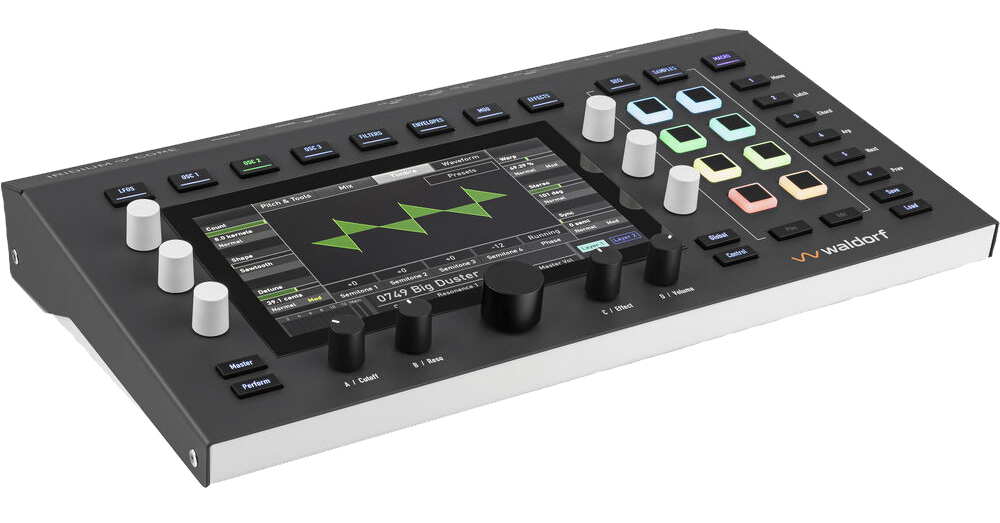
This one’s the new kid on the block, and almost never gets talked about in Psytrance circles. Given the price point of everything in the Iridium and Quantum lines, it’s not hard to see why it gets overlooked. But that is also why for more seasoned artists and folks who want to take their productions and sound design skills out of the box and into a physical unit, the Iridium line is probably the best choice among modern poly synths (and the Iridium Core is less expensive than a Virus TI). The Iridium Core is more or less what you’d get if you cross-bred a Blofeld with a Mininova. You can make all the analog style waveforms go Super-style same as on the Mininova (not the wavetables though, for unknown reasons), greatly-improved FX (including a reverb that surpasses the Virus TI reverb!), and possibly the deepest mod matrix of any other synth. The core sound is really nice, and regarding the core, the 12 stock voices can be expanded to 16 with the 4.1.0 OS update, andd the synth is still receiving updates, so new features are being added regularly (the most recent being a new Shimmer reverb, which is super cool). The Iridium Core would be extremely solid for every kind of Psy, although it seems well-suited to Morning Full On, Prog, Forest, and Dark Psy.

Polyphony: 12 voices (16 with 4.1.0 beta OS update)

Oscillators: 3 oscillators capable of 5 synthesis modes incl Wavetable, Waveform (VA), Particle, Resonator, Kernel

Filters: Multiple Model filters incl SVF, Raiser, Largo, Nave, PPG, and Quantum, in 12/24dB/octave with LP/BP/HP types available

Envelope Generator (EG): 6 LFO, 6 ADSR

Included presets: 1,700 factory patches

Audio outputs: 2 x 1/4" TS jacks Audio inputs: 2 x 1/4" TS jacks

MIDI connectivity: In/Out/USB

USB connectivity: Yes

CV/Gate: Yes

Headphone Output: Yes

Sequencer: 64-step Arpeggiator

Advanced Effects: Reverb (incl Shimmer Mode with 4.1.0 beta 2 OS update), delay, chorus, phaser, flanger, drive, EQ, compressor, tremolo

Display: High-resolution touch screen


CLAVIA NORD LEAD 3
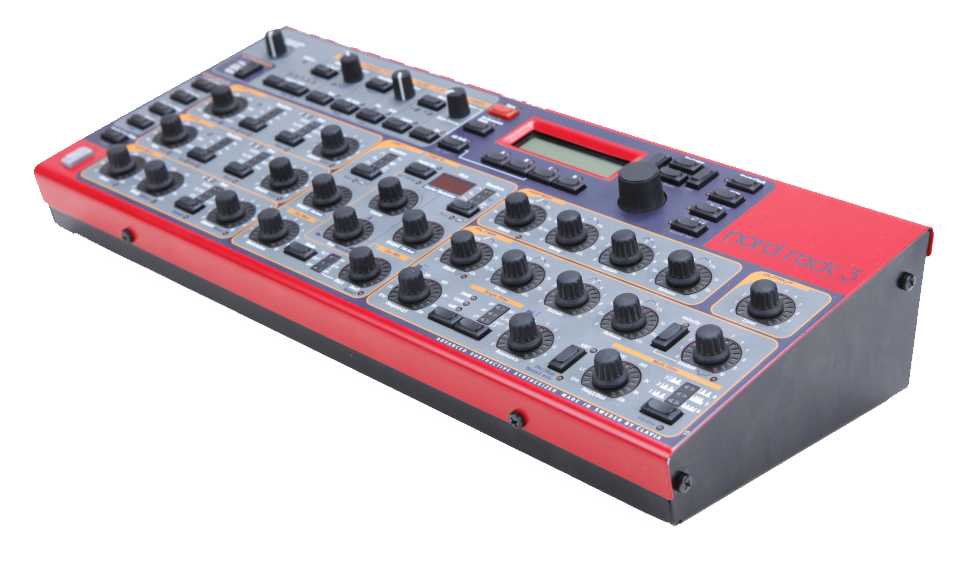
Possibly the most underrated and least-loved synth on this list, the Nord Lead 3 has gotten a lot of ire over the years, but it really doesn’t deserve it. Its core sound isn’t as bright as the Nord Lead 2 or 2X, but what it lacks in top end fizziness, it makes up for by being a monster pad and crazy FM super synth. If Forest and Swamp Psy are your thing, or you are keen on making some late 2000s style dreamy melodic progressive a la Ovnimoon or Invisible Reality, this synth is awesome for those sounds. Just pair with a quality Phaser, Reverb, and Delay, and you’ll be very happy indeed.

Plus, the LED encoders look super cool when you’re producing in the dark and wanna feel like you’re making Psy in a haunted forest.

Polyphony: 24 voices

Oscillators: 2 oscillator groups each with Six waveforms: sine, saw, triangle, square (pulse with width modulation), noise, synced noise, dual sine; 2- and 4-op FM and differential FM; osc-sync; ring-modulation; variable unison.

LFO: 2 per voice, syncable to MIDI. Triangle, saw, square, smooth and stepped random, and triple-peak sine waveforms. Seperate vibrato effect.

Filter: 2 multi-mode filters (series or parallel). Lowpass, Bandpass, Highpass, LP-HP, LP-LP and Classic mode. 1-, 2-, or 4-pole.

VCA: ADSR envelopes for amplitude and filter; Amplifier Gain control

Memory: 1024 patches, 256 performances

Control: MIDI IN/OUT/THRU (4-parts)


Roland JP-8080
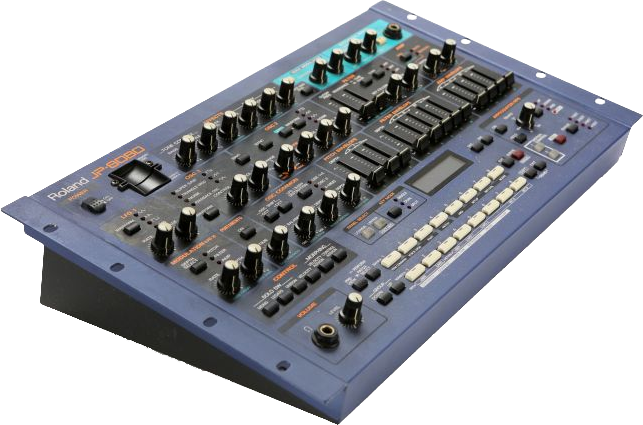
Most folks know the JP-8080 as a Euro-Trance synth, but it’s still really great for mystical, epic sounds for Full On and Prog Psy. Amiranu told us that many many years ago, Namarrkon even offered to sell him his JP-8080, which he had used to produce his Earthbound EP, which alongside the song Hero by Mr Peculiar, is what inspired Amiranu to get into producing Psytrance in the first place. Amiranu says he had to turn down the offer, as he was broke at the time, and the shipping from Australia would have been killer, but later he got one of his own, and confirms it is indeed awesome for Full On and Progressive. So if it was good enough for Namarrkon, it’s good enough for anybody. Plus, The Usual Suspects released a VST plugin version of it, JE-8086, and Adam Szabo also made a JP plugin called Airwave, and Arturia and DiscoDSP also have versions out, so even if you can’t spring for an original 1998 hardware unit, the actual sounds of the gear are accessible to anyone at any budget.

Polyphony: 10 voices

Oscillators: 2 Roland Analog Modeling DSP oscillators: Saw, Square (PWM), Triangle (PWM), SuperSaw (7 de-tuned Saws), Triangle Mod, Feedback OSC

Filter: Resonant 12/24dB/oct low/band/hi pass, 12-band formant filter bank

Effects: 3 onboard effects: Delay; Multi-FX including Chorus, Flanger, Distortion and Tone control

Memory: 384 preset and 128 user patches; 192 preset and 64 user performance

Arpeg/Seq: Onboard Arpeggiator and real-time Phrase Sequencing (RPS) capability

Keyboard: None

Control: MIDI (2 parts)


MOOG SUB 37
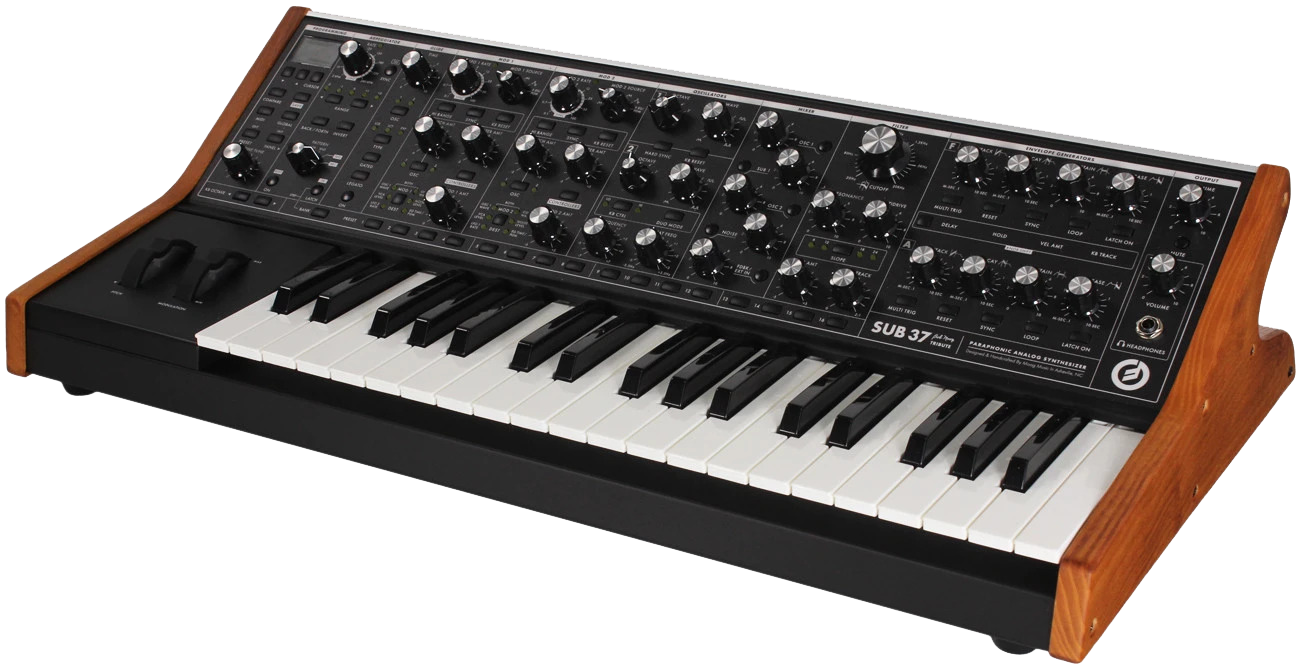
It’s not super common to find mono/duophonic synths in Psytrance, but the Sub 37 deserves inclusion because for a mostly-mono synth, it has deep mod capabilities, and a base tone that is really nice for heavy full on basses, and gritty leads. Achieving screechy electric FM noises is tricky, and hipassed/bandpassed resonant zaps are basically impossible, but warm lopassed leads, rolling basses, and single-note plucks all come out really nicely from this machine. Pair it with solid reverb, delay, phaser, chorus, and rate reducer, and you have a top tier analog mono synth to put at the center of your psy spaceship.

Polyphony: Monophonic / Duophonic
Timbrality: 2

Oscillator: 2

LFO: 2

Synthesis type: Analog subtractive

Filter: 1 selectable 6, 12, 18 or 24dB/octave low-pass

Attenuator: ADSR

Aftertouch expression: yes

Velocity expression: yes

Storage memory: 256 patches

Effects: none

Keyboard: 37 keys

External control: MIDI, CV/Gate


KORG MINILOGUE XD
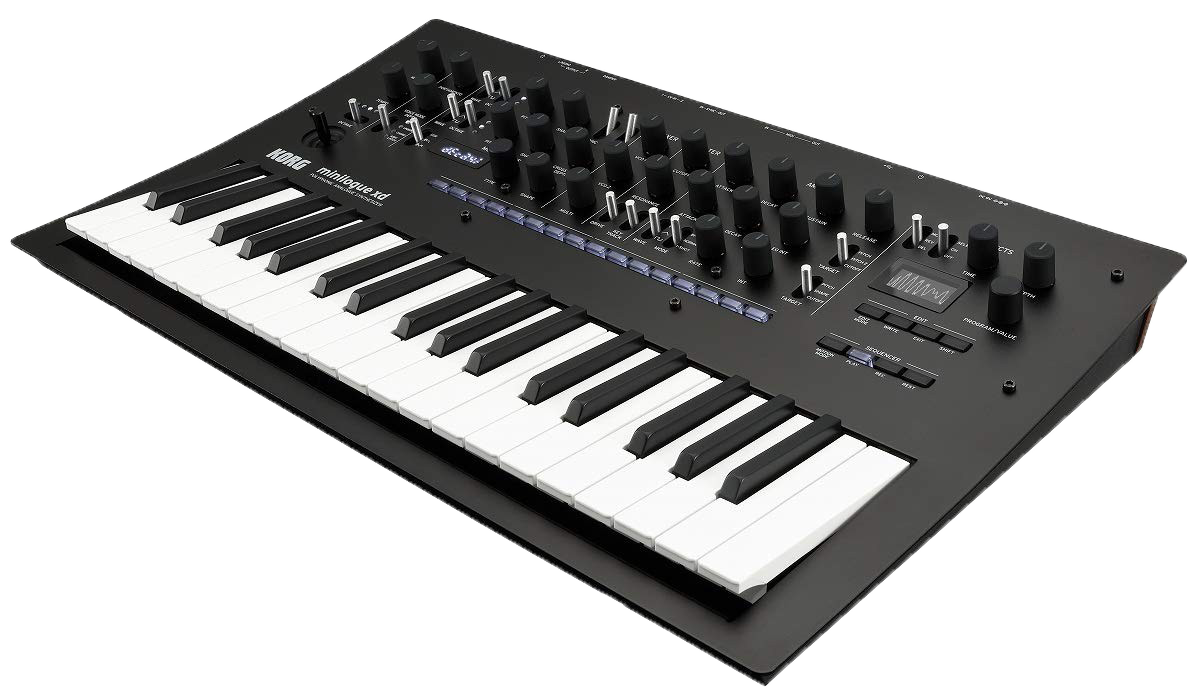
minilogue xd psytrance

Another synth that’s rarely talked about in Psytrance circles, the Minilogue XD is a secret powerhouse of a unit that lurks in between the Prophet Rev2 and the Sub 37, with some unique features all its own. You can create and upload your own oscillators, and it has FM, and a few extra FX like Ensemble, that give it more depth than other analogs. The 4 voices of polyphony present a bottleneck to just how much you can do with it, but if you relegate it to just leads, plucks, acid sounds, basses, bass pads, and FM screeches and zaps, you can get a lot of mileage out of it. With a little post-processing you could also do some FM using the wavetable side of the synth to create haunting evolving textures, and then do some pan mods and add Valhalla Supermassive reverb to them after the fact to create extra spooky swamp and forest psy ambiences.

Sound Engine: Analog sound generator + Multi digital sound generator

Analog/Digital: Hybrid

Number of Keys: 37

Type of Keys: Slim-key

Velocity Sensitive: Yes

Other Controllers: Joystick

Polyphony: 4 Notes

Presets: 500 Voices (200 factory, 300 user)

Oscillators: 2 x Analog VCO (sawtooth, triangle, square), 1 x Digital (noise, vpm, user)

LFO: 1 x LFO (sawtooth, triangle, square), BPM, Normal, 1-shot

Filter: Sharp Two-pole

Envelope Generator: 1 x AMP EG (ADSR), 1 x EG (attack, decay, EG int, target)

Effects Types: Chorus, Phaser, Flanger, Delay, Reverb, Ensemble

Arpeggiator: 4-voice with Latch mode

Sequencer: 16-step Polyphonic Sequencer, Motion Sequence, Realtime Recording

Audio Outputs: 2 x 1/4" (L/Mono, R)

Headphones: 1 x 1/4"

USB: 1 x Type B

MIDI I/O: In/Out/USB

Pedal Inputs: 1 x 1/4" (damper)

Other I/O: 2 x CV in, Sync in, Sync out

Software: Minilogue Librarian Software

Power Source: 9V DC power supply (included)

Waldorf Iridium Core Review 2026

WALDORF IRIDIUM CORE REVIEW 2026

Every synth manufacturer has its near-mythical legendary flagship synth that lives in a price realm beyond that which mere mortals can afford. Sequential has the Prophet 10. Moog has the Moog One. ASM has the Leviasynth. Access had the Virus TI2. Roland’s Jupiter-8, despite being long out of production, still commands prices that put many used cars to shame. And Waldorf, has the Quantum MK2.

But all those manufacturers also have budget versions of their legendary synths priced at points for more affordability. Moog has the Messenger. Sequential has the Fourm (or Prophet Rev2, if we’re talking about more full-featured synths), Access had the Virus TI Snow, Roland has an army of boutique synths, and Waldorf… has the Iridium Core.

If the Blofeld was Waldorf’s budget version of the Q and XT in a compact package, their Iridium Core is the budget version of the Quantum and Iridium, both tremendously powerful synths in their own right.

The Quantum is famed for its sound, synthesis depth, and… questionable build quality. The first Iridium also suffered from a couple similar issues. But the deep sound engine still remained (and subsequent repair kits to fix the build issues). So how does the Iridium Core, the stripped down, Blofeld-esque synth in this lineage, stack up against its bigger, knobbier, more expensive ancestors?

Let’s take a look.


iridium core OSCILLATOR section

Naturally, the first place to start is with the tone generators themselves. And what can we say here?

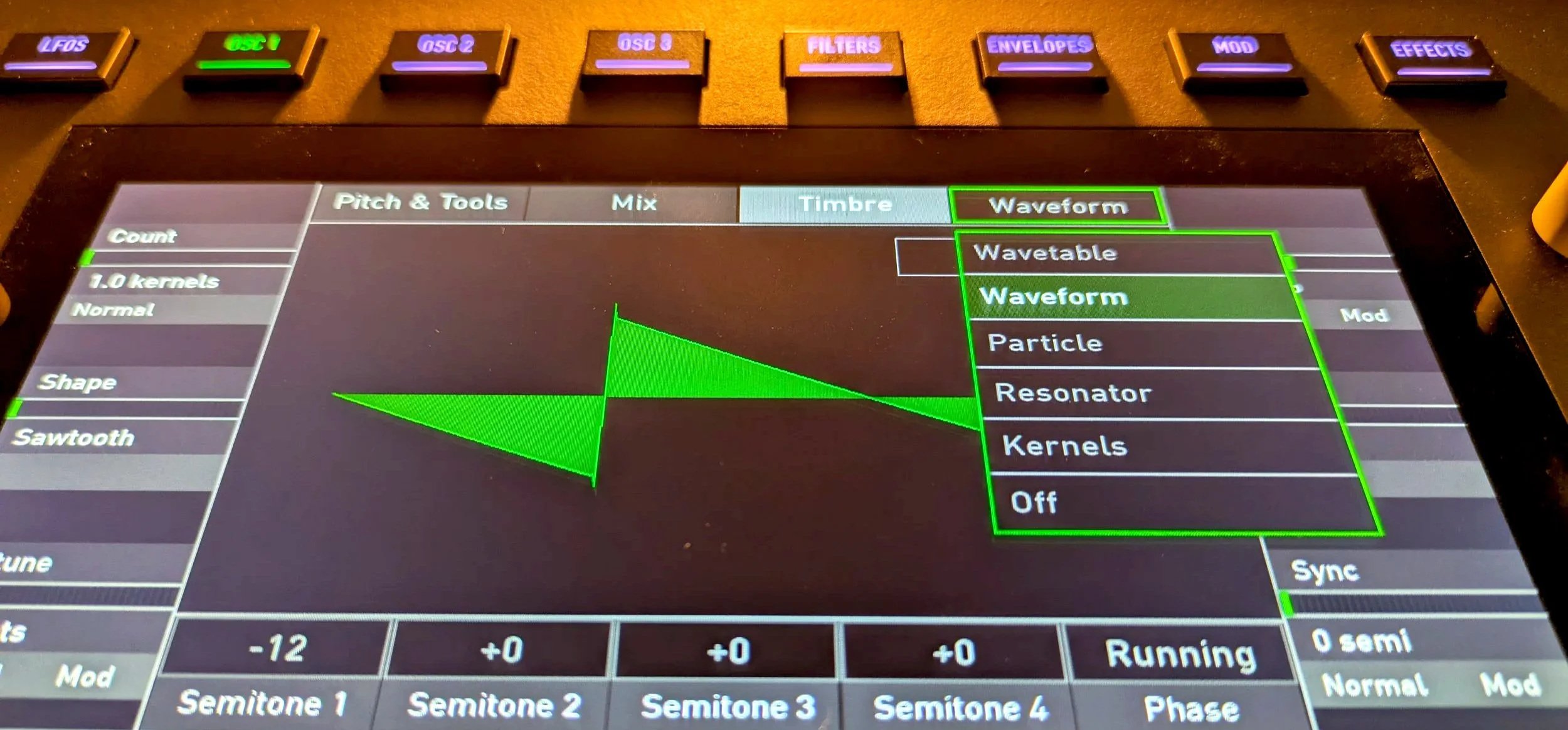
The Wavetables are Waldorf’s bread and butter, and all the wavetables from the Blofeld (and presumably the PPG Wave) are here, with even more and more complex modulation capabilities and controls than ever. This is also the only section where the oscillators have a dedicated Brilliance control to amp up the high frequency content without needing to use an EQ. The 3D style view it defaults to when you boot it up is pretty cool, and it’s hypnotic to scan through the waves. There’s certainly a lot of magic to be had in here, especially with a touch of Unison, Chorus, Phaser, Delay, and generous amounts of Shimmer reverb.

The Waveforms section is our real bread and butter, as most genres of music we make sounds for lean on analog and VA waveforms. Your standard Sawtooth, Triangle, Sine, Pulse, are all there, with Warp controls for added wave sculpting/ pulse width modulation, and there are also extended waves like White Noise, Pink Noise, Geiger, and others.

What’s super nice about the Iridium Core’s Waveforms is the Kernels feature on each oscillator. They describe it as up to 8 sub oscillators applied to each etc etc, but really, what that means is that it allows you to Super- whatever oscillator you’re using. SuperSaw? Yup. SuperSine? Yep. SuperSquare? You betcha. All the analog waves can be Supered. You can detune with any degree of granularity you want to go, from nasally to Hardstyle screech. And there are Stereo controls that allow you to spread each of those kernels across the stereo field to achieve unison pan spread-like width, without sacrificing the polyphony to do it. Personally, we avoid using it and still use Unison or the Pan controls in the Mixer section, because the Stereo control on the individual oscillators spreads the notes apart and un-detunes the sounds, so if you want big majestic SuperSaws for a pad or lead, you lose the detuned lush sound as the tones spread across the stereo field and stop interacting closely with one-another’s harmonics. So we still use a couple different tricks to keep sounds epic and wide. In general, we find the actual timbre of the Waveforms to be a little like a Nord Lead 2X, or even a Prophet Rev2 at times. Which, if you know us and how much we love those synths, it’s not a bad comparison. The sound feels a bit thicker than the Blofeld, which may be a product of the filters rather than the oscillators, but we’re sure the source tones from the oscs play a part in the thicker sound. SuperSaw type sounds on the Iridium Core also come convincingly close to the JP-8080, and with a couple small EQ and FX tweaks, you could make sounds basically indistinguishable from an original JP.

There’s also a PitchVar feature hidden in the Pitch section of the Oscillators you can play around with to get varying amounts of random pitch drift, which is great for nailing proper classic analog sounds (alongside an EnvelopeVar, which will be mentioned later).

After that section, we start wandering out into strange and unexplored territory. The Particles mashes together granular and sample-playback synthesis, and frankly we’ve never used those features on anything except partially on Omnisphere, and we haven’t yet encountered a practical use for it for the kinds of sounds we make. That’s not to say we won’t ever. But we just haven’t yet. We do anticipate interesting uses of it in future banks though.

The Resonator is also a trip. We’ve tinkered around a bit with it, and it seems like an interesting way to generate crazy metallic and glassy sounds. Since it seems to operate off playing bandpass filters off each other while being affected by samples and noise, it sounds like the perfect section to create extra weird noises for dark psytrance. And maybe certain kinds of FM-style basses for Slap House or 80’s nostalgia tones.

Kernels is the final and 3rd most familiar kind of synthesis most folks will know. That’s the Iridium’s take on FM Synthesis, and predictably, that section is complex, and not a little opaque. There are a number of presets buried in that menu zone that spit out various bell and clang and glass tones, and in our tweaking with it, we almost managed to nail some of those dirty FM sounds that would work really nicely in dark psytrance and as midrange arp-basses for uplifting trance. It’s not as easy to mess around with as FM is on the Blofeld, but it looks like experimentation (and reading the manual) will reward the adventurous in there.

Overall, this synth offers an almost overwhelming amount of synthesis options, and feels a lot like a Hardware Omnisphere. The only downside in here is that the Noise generators are lumped in with everything else rather than living in their own space as independent generators (like in the case of the Blofeld, Virus C/TI and Mininova), so you have to sacrifice an oscillator to use Noise, which is a bit of a bummer. It’s not a dealbreaker (the same situation applies on the Nord Leads and JD-08 and JP-8080 as well), but just a bit of a bummer.


iridium core FILTER section

This is one of the more interesting of the Core’s features. It has the same dual-filter architecture with different filter slopes and styles to choose from as its Blofeld ancestor (Lopass, Hipass, Bandpass, etc), but there are notably more options to choose from as far as filter models. SVF is its default filter type, and as can be expected, it has a pretty typical digital filter sound, not unlike the Blofeld.

After that, we start getting into interesting territory. Raiser sounds like Waldorf’s answer to Moog’s famous Ladder filter, and while I’m not sure it behaves or sounds exactly like a vintage analog Ladder filter, it does sound nice on the 24 dB slope. It doesn’t sound entirely analog, but it is nice.

After that there are Largo and Nave style filters, which I’m not the biggest fan of. I designed a bank of patches for Largo, and was not as fond of its filter as the Blofeld’s.

Where things get cool is with the PPG filter model. That actually sounds the most analog of the filters on the unit, and it does some really nice round and juicy bass and pluck and acid sounds, especially when selecting the Sat or Dirty 24dB filter types. I found myself using this one a lot when designing bass and other patches that I needed to sound more “analog”, because it was the most convincing digital emulation of an analog filter I’ve heard outside the Virus line.

And the addition of the Quantum filter model is a nice addition. I haven’t had a chance to get my hands on a Quantum to A/B test the analog filter in person, but I suspect that the real thing sounds a bit richer than this emulation. But having said that, including it here is super helpful, as it means I can design analog style pads and plucks and basses on the Core, and a Quantum user can load them straight in and have the sounds come out the other side of their true analog filters sounding really nice and proper, without having to manually tweak parameters or swap filter models to get them working right (an issue one of our devs has encountered porting 4-pole Lopass Filter sounds from the Virus TI2 down to work on the Virus B)

If your aim is chasing vintage analog tones with vintage analog filters, the PPG filter really wins the day here.

Bear in mind, if you want to use a Comb Filter, it doesn’t live in the Filter Type or Model menus. The Comb filter has been relegated to the Digi Former menu, which we found slightly annoying, as we like doing things like combining rate reducer effects with comb filters to create trippy psychedelic textures for Dark Psytrance and Ambient soundscape patches. You will have to make choices here for comb filters and degraded sample reduction effects.

Now is actually a good time to discuss the Digi Former section in a bit more detail.

It basically acts like a filter-level effect section, mostly devoted to Drive/Distortion effects, rate/ bit rates, comb filters, and other modifiers. You can set the effects to affect the sound before and after the filter, to change the intensity of it, which is nice. On the Blofeld the effect always affected the sound after the filter, so subtlety was hard to achieve except at very low amount settings. So you can add gentle tube saturation to sounds on the Iridium Core the same way you could on the Blofeld, but even more gently.

The Bit Crusher is super nice, and is a lot of fun to mix and match different Bit and Rate amounts, to create super grainy and crunchy noises. One feature we would really like to see in a future update on the Iridium Core though, is a Mix control for the Rate/ Bit Reducer on the Digi Former. Or have the whole effect shifted around to become a dedicated effect in the FX section. It sounds really nice, but having its volume on a sound sitting at one level, makes it hard to create subtle grains and crunch to sounds. The Level control in the Digi Former parameter affects the entire patch’s level, which is inconvenient when trying to add subtle talking rate movement to a bass patch. Your choices are either super loud and overwhelming grit, or so subtle you can’t hear the grains of the sample rate reduction. At least the available parameters of the effect can be modulated in the Mod Matrix, so you can do rate-reduced talking sounds, which is a feature we sorely wished for on the Blofeld. That is super nice.

Another feature that would be cool to see would be an 18 dB/ 3-pole filter, especially on the analog model filters, for achieving more classic 303 style Acid sounds. The original TB-303 had an 18 dB 3-pole filter, and the Mininova and Virus TI2 have it, and it makes it easier to create really classic Acid sounds on those.

It’s still totally possible to make killer Acid sounds on the Core, don’t get us wrong. We made plenty of them. We just know the really authentic sound would be even easier to replicate on a 3-pole filter, which would be awesome to see here.

The dual filter behavior is a lot of fun to experiment with, and we used the dual filter on the Virus TI2 to roughly emulate analog lopass filter sounds on it with the standard lopass, and we also tinkered around with the same idea here with the Core, since it’s also pretty easy to dial in the balance of the filters. Having 2 independent filters is definitely a must for all Ambient and Psytrance and Dub Techno producers, and if creating hazy morphing chord sweeps with tons of movement across mixed hipass and lopass/bandpass filters with lots of reverb and delay and phaser is your thing, you will not be left wanting, here.


iridium core ENVELOPE section

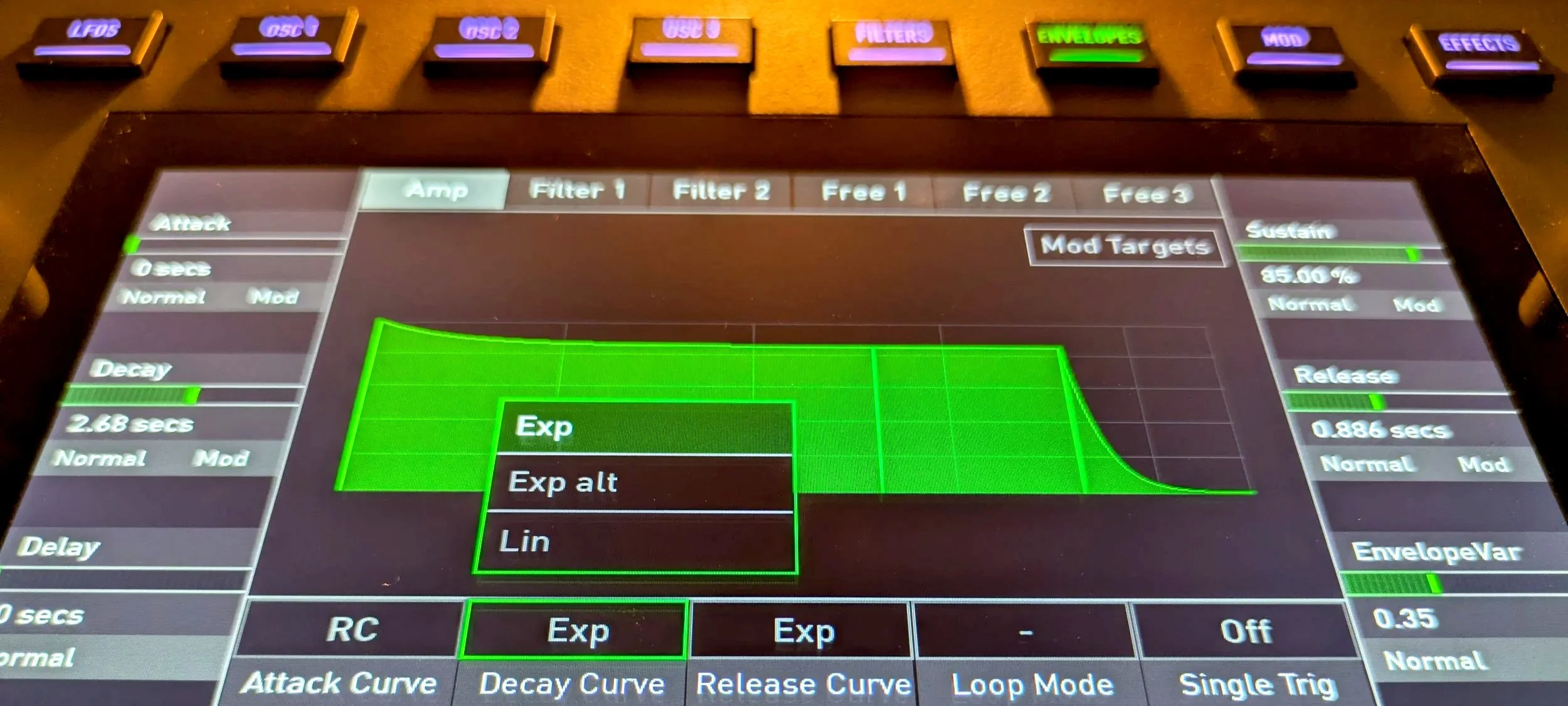
This is another very interesting section for us. On most synths we’ve worked on, the Attack, Decay, and Release curves are what they are, and whatever their default slopes are, that’s what you get. With the Iridium Core here, you can’t fully tweak the curves to custom slopes, but you can switch between very straight digital linear curves, and a couple exponential curve modes that mimic different analog and VA envelope slopes. And for making analog-style plucks and leads, and pads with long tails, having all those options available is really nice.

The EnvelopeVar feature is also cool, although can be a bit weird to work with if you don’t expect it. Along with PitchVar that lurks in the Oscillator Pitch menus, it randomizes parts of the Envelope slopes by whatever amount you set, to mimic vintage analog synth VCA/VCF envelope behavior. If you’re after pure digital envelope precision for genres like Trance or Dubstep, you’ll want to dial this feature down or turn it off, as it can mess around with note consistency in plucks and short lead sounds.

But overall, this is a huge improvement over the Blofeld’s filters, and the only other synth I can think of with even close to this kind of depth of control over filter slopes and such is the Virus TI2 with its Sustain Slope modifiers buried in the Envelope submenus.

The Iridium Core is definitely a synth where you can make this thing’s envelopes sound as analog or digital as you want.


iridium core LFO section

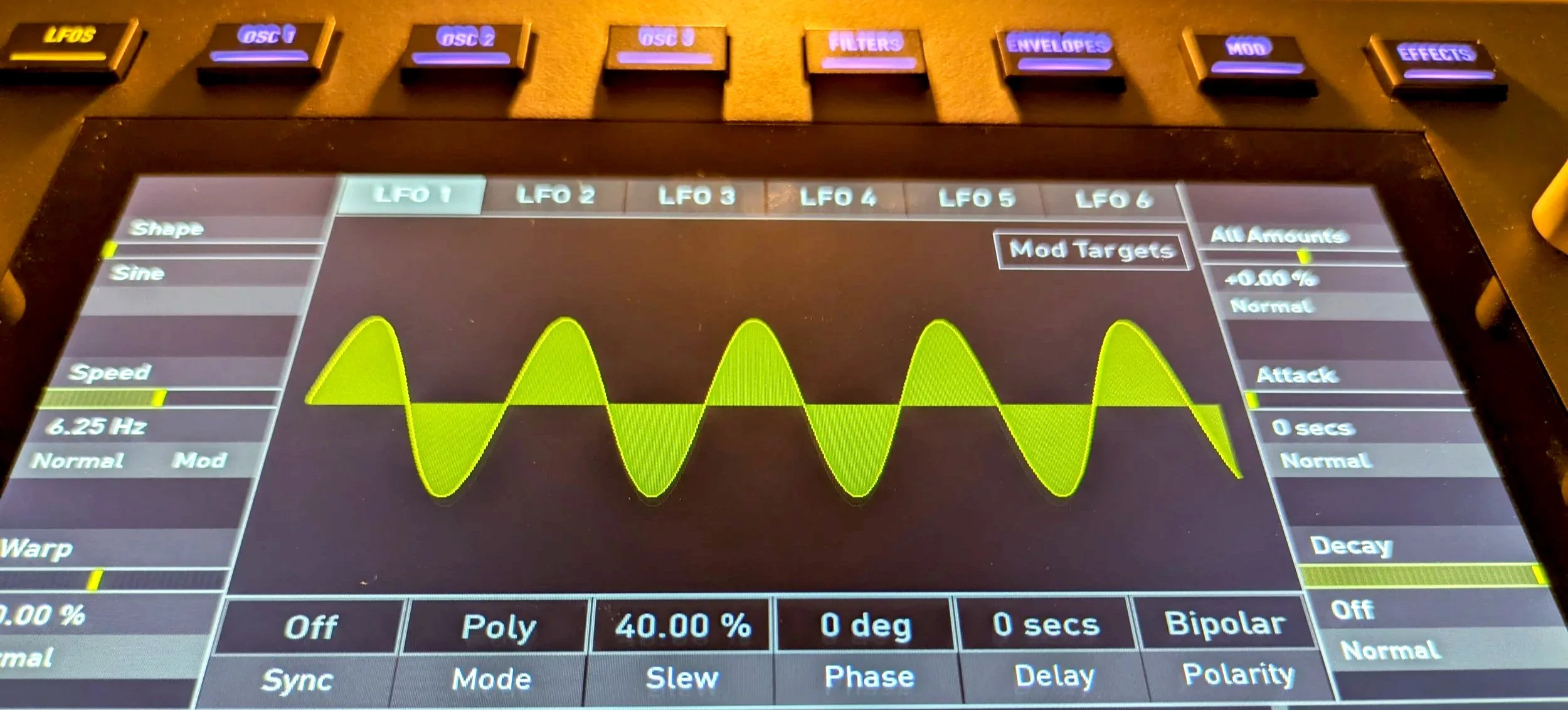
The LFOs on the Iridium line… are wild. Call us crazy but 6 LFOs almost seems like overkill. But we pulled an Ambient soundbank out of a Slim Phatty, so, take that for what you will. Anyway, the LFO section isn’t too out of the ordinary, especially for users of the Waldorf Blofeld or Novation Mininova. Slew, Phase, Delay, and other such features are on both, and are present here.

At first, we were annoyed at the lack of a Random LFO waveshape, until we discovered the Rand and Rand Bipolar Mod Sources in the Mod Matrix. We kind of miss the Random LFO, because you could adjust the “speed” of the random lfo cycles, but random is random, so whatever works. Besides that, the LFOs work just fine and are plenty tweakable for all kinds of modulations.


iridium core MODULATION Section

Waldorf Iridium Core modulation section

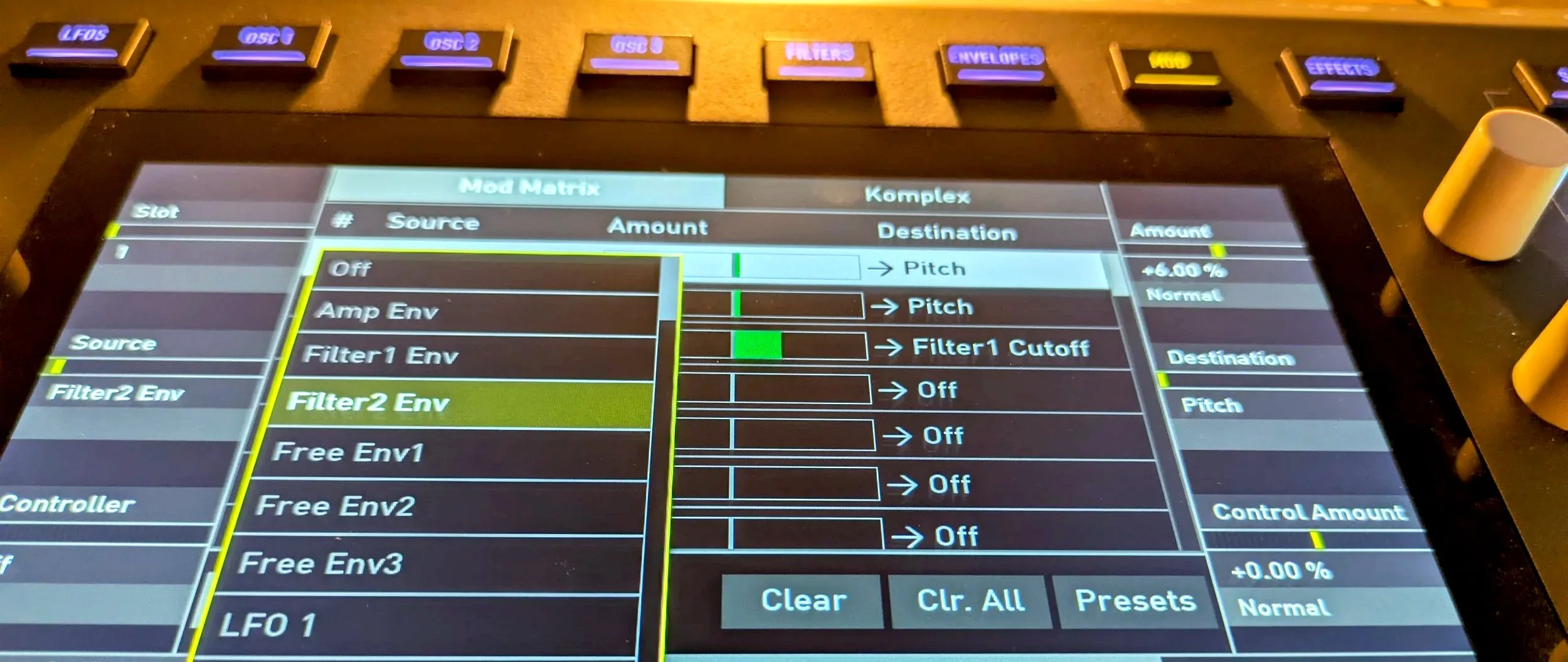
Onward we go to the Mod Matrix. This has always been one of Waldorf’s strengths, and the Mod capabilities of the Iridium Core are flawless. Just about everything can be a destination, and the bonus Controller function eliminates the need to use other mod slots to set up parameter mod chains.

The Komplexer is also quite interesting, and we had a fun time working at setting up Trancegate sequences in it for gated pads. We haven’t quite worked it out completely yet and gotten it to yield the results we want, but we’re going to continue experimenting with it in the future. This synth is a soundseeker’s dream.


iridium Core EFFECTS

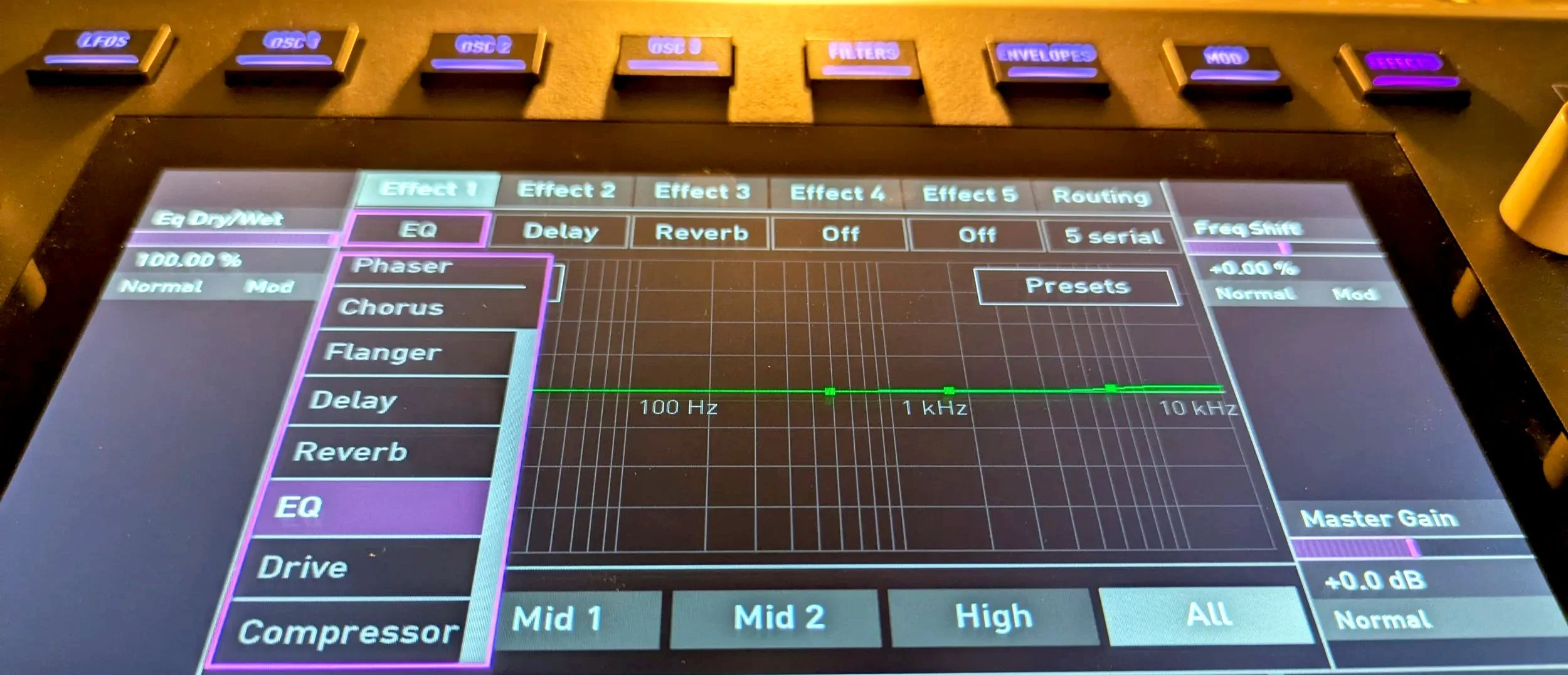
Waldorf Iridium Core Effects Section

No doubt a fair few of you remember the Blofeld and its… lackluster reverb and phaser.

This is not the case here.

Waldorf completely overhauled all the FX, and these are world-class effects under the hood on the Iridium line now.

The EQ section is super helpful for tweaking the finer bands of sounds, the phaser finally sounds like a phaser and is about at-par with the legendary Virus Phaser, and the Chorus is substantially improved over the Blofeld. We had a tricky time trying to make it sound like a classic JP-8080 or Virus Chorus, but we’ve gotten pretty close results, and we’ll get closer the deeper into this machine we get.

The Delay finally sounds nice and full, and has lots of tone-tweaking controls to help it stay clean in a mix. Hopefully someday they add a Tape Delay setting in there, to facilitate some of those classic delay behaviors that makes Dub techno and Ambient so fun to experiment around with.

Flanger is also a nice touch, and is great for trippy Psytrance sounds and effects.

The Drive/ Distortion section is also nice (although we’d be lying if we didn’t admit we miss some of the old Blofeld distortion algorithms. The Blofeld could get mean and make some truly aggressive Dubstep and Industrial sounds with its distortion effects.

We must confess we are not the biggest experts at wrangling Compressors, and our own efforts at messing around with it in here had mixed results, so we’re not the best judge of how the Compressor in here is.

But we all know what you really want to know, is if the Reverb is any good.


And the answer is a solid resounding YES.

It can sound as massive and spacious, or as tight and confined as you want, and it has all kinds of mod and color controls to make it bright and airy or dark and lush, in any degree. And that’s just the standard reverb. As of October 20 2026, a new beta OS update (4.1.0 beta 2) for the Iridium Core gave it an additional Shimmer Reverb setting, which we have only barely scratched the surface of, but were extremely impressed in our early tests. The pitch warbles and creates spectacular Hans Zimmeresque cinematic tones that sends even the most basic synth plucks soaring off into the orbits of distant black holes. The regular and shimmer reverbs are going to be very hard not to abuse and overuse on soundbanks going forward. They just sound too frickin’ good. Definite Virus Competitor, these.

And what’s also great is these FX are freely-assignable to any slot in the 5, so you can play around with the interactions of the different FX however you like. Within that, if you decide to shift an effect over to a different slot, the Iridium remembers its parameters, so you don’t have to manually recall and tweak the parameters if you move the distortion from slot 2 to slot 5. That’s a nice touch.

You can hear what the FX sound like on patches from the Novation Mininova here (including the new Shimmer reverb from the recent beta OS update).


CONCLUSION: Is The Iridium Core Worthit?

Waldorf Iridium Core review conclusion

So, here at the end of it all, the question remains: Is an Iridium Core worthit? Do the features justify the price?

Thus far, we would have to say, yes.

In a world where the Access Virus TI2 and Waldorf Q and Supernova II Pro X are long out of production and the Blofeld just ceased production, there is definitely a place in the market for a multi-engine VA/Wavetable/Sample-Processor synth with absurdly deep mod capabilities. Too many synths out there (in our opinion) are being released with either too small a featureset, or too few voices, and even at 12 stock voices, the Iridium Core punches above many other current synths on the market. The build quality of the Iridium Core is sturdy and the funky falling screen issues of past Iridiums and Quantums seems to have been resolved.

We scored our Iridium Core for less than our Prophet Rev2, and in that regard were exceptionally fortunate. But having said that, part of what makes the Iridium MK 1 and 2 so expensive are the knobs and extended new features (obviously).
And being long-time users of the Blofeld, working on minimalist interfaces doesn’t scare us. The Iridium Core is even more intuitive than the Blofeld, and the Blofeld wasn’t too hard for us. And the smaller featureset/ polyphony of the Iridium Core is, as of October 2026, is not the issue it was when the Core first dropped several years ago.

Back in September, Waldorf released the 4.1.0 beta OS update that increased the polyphony from 12 to 16, which we’re sure is a simple software change adding 4 extra dynamic voices that may or may not disappear under heavy DSP loads. But for most of what we do, that’s not going to be a problem. So we paid for a 12 voice synth, and got a 16 voice synth. And just earlier this week they dropped 4.1.0 beta 2, with added Shimmer and updates to the Favorites menu system. So the hits just keep coming.

And thanks to these frequent and not-inconsequential OS updates, we’re being treated to all kinds of new effects and fixes that are rapidly making the Core close the gap with the Virus TI2. The practical utility of this synth is increasing for free just about every month, and that effectively makes it a synth worth its sticker price, and then some.

We’ve coaxed all kinds of superb sounds out of this machine in the relatively short time we’ve had it, and by the time you read this we will have made even more.

So if you’re a dance or ambient producer looking for a new hardware synth that will rock hard at the genres you make, and won’t suddenly die on you due to obsolete part failure because it’s 30 years old, the Waldorf Iridium Core is an excellent choice that is well worth the money (especially as time goes on and more updates and fixes add features and iron out kinks).

You can typically find them priced between $1200-$1900 USD, but we got ours for $1195 (and a bit extra for shipping).

Our First Waldorf Iridium Core Soundbank Is Out Now!

You’ve known us for making uplifting and classic trance presets for oldschool and vintage synths like the JP-8080 and Nord Leads and Viruses for years, and… after a fateful weekend at Superbooth this past May, we finally caved to our case of GAS and got our hands on our first truly modern synth, a Waldorf Iridium Core, in August!

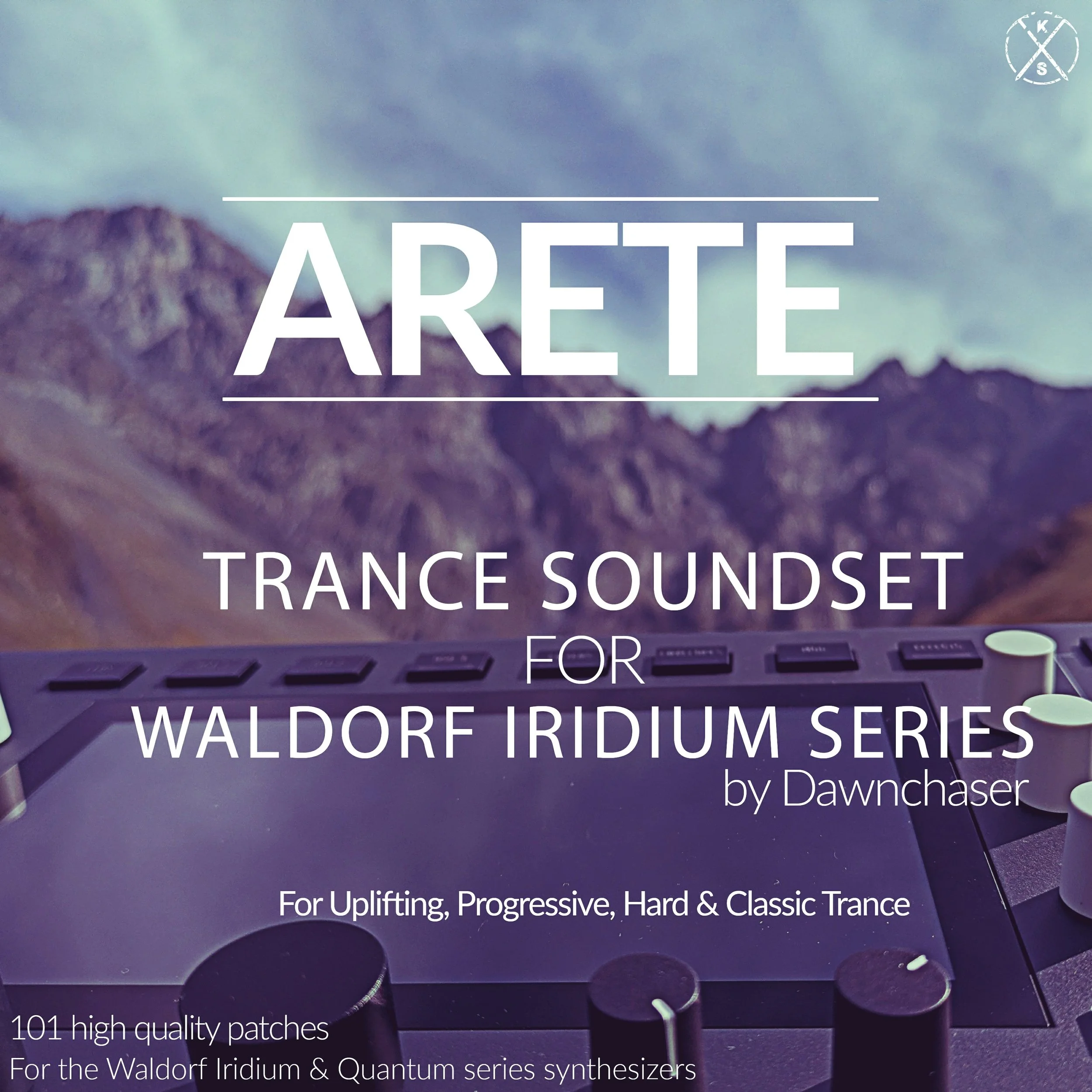
And after wrapping up some other soundbank work, we are proud to announce we have finally released our first Waldorf Iridium Trance soundset: the Arete Trance Soundset for Waldorf Iridium & Quantum Series!

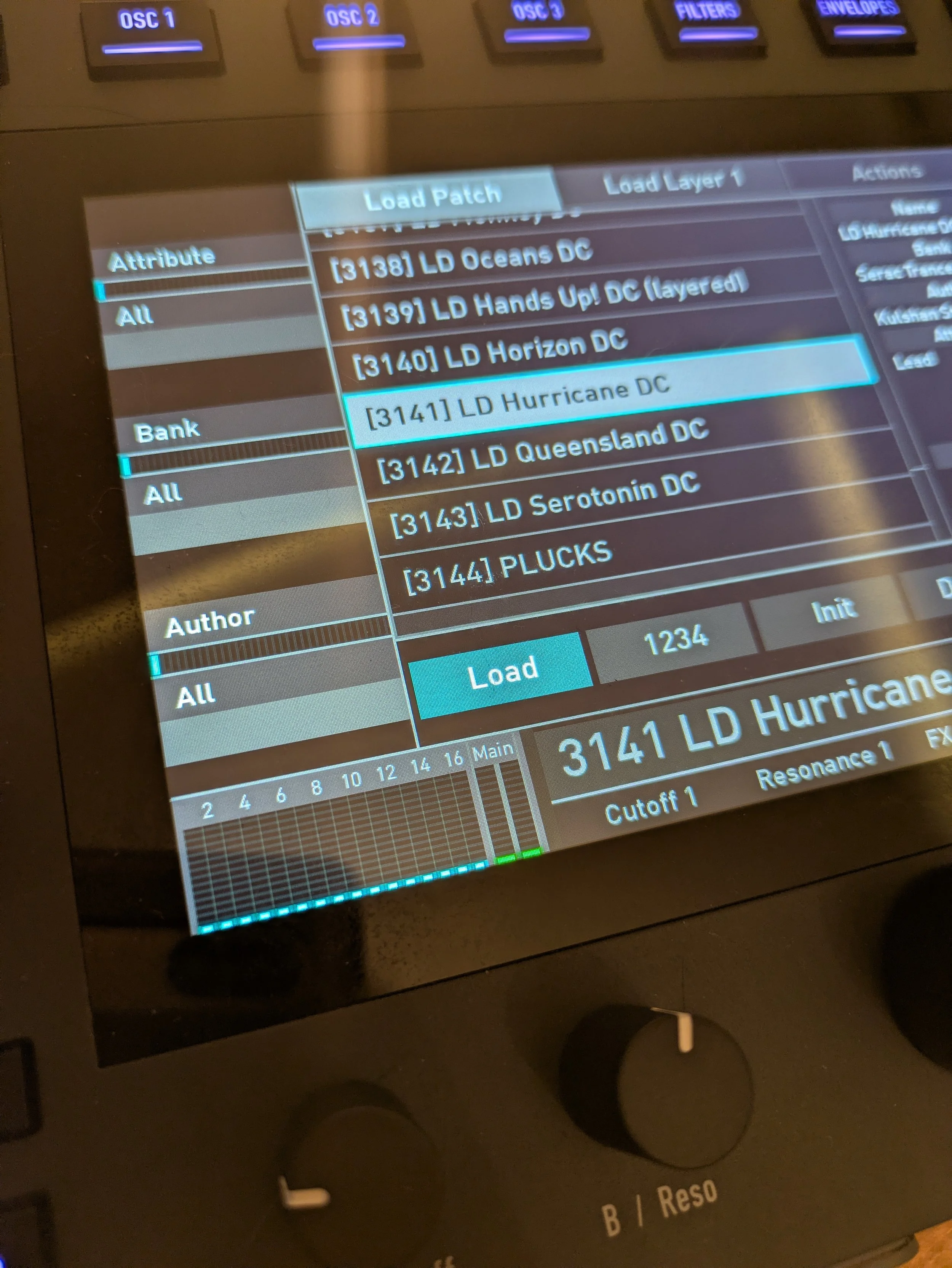
It’s loaded with 101 patches, designed using the latest beta OS update for the Iridium Core (the 16 voice expansion update), all inspired by classic and modern uplifting trance tunes, designed by Dawnchaser to be 100% production-ready for your tracks straight out of the synth. So whether you're working on the full-size Iridium or Quantum, or using an Iridium Core, these sounds exploit the full power of the engine.

Arete has already been reviewed by GearNews, and you can check out their full feature and review right here! We’re thrilled by the response thus far, and can’t wait to hear these patches in your releases!

Check out the demo below, and keep an eye on this space, as this is certainly not the last soundset we’ll be making for the Waldorf Iridium and Quantum synthesizer line!

Arete Trance Soundset for Waldorf Iridium & Iridium Core & Quantum Series
$35.00

101 uplifting Trance presets, compatible with the Waldorf Iridium, Iridium Core, and Quantum hardware synthesizer series. This soundbank is 100% Trance-oriented and comes packed with euphoric leads, majestic pads, thundering basses, epic plucks, and screaming 303 acid patches, with no filler sounds. The patches in Arete come straight out of songs written using the legendary Waldorf Q, XT, microQ, Blofeld, and Pulse synths. Designed to fully exploit the Iridium’s advanced virtual analog engine, complex wavetables, deep mod matrix, and dual multi-mode filters, this soundset pushes the Iridium and Quantum to their fullest potential!

Patches in Arete are based on sounds from songs by the likes of Rank 1, Pulser, Driftmoon, Armin van Buuren, Ferry Tayle, 7 Skies, DuMonde, Arctic Moon, Wavetraxx, Aly & Fila, Tom Porcell, Giuseppe Ottaviani, Roger Shah, Ferry Corsten, Ralph Novell, Basis 1, Gaia, Alphazone, Aimoon, The Mystery, Dawnchaser, Denga & Manus, The Thrillseekers, Airbase, BT, Manian, Ace Da Brain, Akira Kayosa, Ron van den Beuken, Scooter, DJ Scot Project, Vengeance, Marcel Woods, Ruff Stuff, K-System, Mike Shiver, Phalanx, and many many more!

No additional FX were applied to these sounds post-recording

Many sounds use the Modwheel for added control

Sounds in this preset pack are suitable for the Uplifting Trance, Hard Trance, Tech Trance, Progressive Trance, and Classic Trance genres, and are organized by category into Leads, Plucks, Pads, Acid sounds, and Basses, for quick reference

All patches are royalty-free and delivered instantly via email as a 24-hour download link


Requirements: Waldorf Iridium synthesizer

Also compatible with Waldorf Iridium Core and Waldorf Quantum Series

“This bank makes full use of the Iridium’s powerful VA and wavetable engines and those superb filters that make it stand out from the crowd.” - Rob Puricelli, GearNews

Waldorf Iridium Core OS Update!

Important info for all Waldorf Iridium Core users out there!

Waldorf just dropped the 4.1.0 b1 beta OS update for the Core that improves a number of features, most notably it increases the available polyphony from 12 voices to the Iridium line standard of 16!

So now you can turn your Core into a full-fledged Iridium for free!

And it’s also worth grabbing, because our soundbanks for the Iridium Core were made using the update, to make epic pad design work easier, so if you wanna get the most from our patches, grab the update!

Waldorf Iridium Core displaying 16 voices after 4.1.0 b1 update

Hear the OS update in action

~ "The preset banks by Kulshan Studios immediately brings out the very best of what the Roland JP-8080 has to offer" - Armada Music Publishing

~ "Kulshan Studios rebuilt the Discovery Pro Factory I bank and the result was excellent." - DiscoDSP

~ "Kulshan Studios’ presets played a huge part in the success of BioTek 3. Bold, beautifully crafted sounds, expertly mapped for expressive, evolving tactile control." - Tracktion

~ "I couldn't recommend these enough. Kulshan Studios made me love the MiniNova even more." - AltWire

~ "This collection of superb sounds properly shows off everything that makes the Blofeld a much-loved synth." - GearNews

~ "High quality soundsets! 5/5" - DuMonde

~ "The preset banks by Kulshan Studios immediately brings out the very best of what the Roland JP-8080 has to offer" - Armada Music Publishing ~ "Kulshan Studios rebuilt the Discovery Pro Factory I bank and the result was excellent." - DiscoDSP ~ "Kulshan Studios’ presets played a huge part in the success of BioTek 3. Bold, beautifully crafted sounds, expertly mapped for expressive, evolving tactile control." - Tracktion ~ "I couldn't recommend these enough. Kulshan Studios made me love the MiniNova even more." - AltWire ~ "This collection of superb sounds properly shows off everything that makes the Blofeld a much-loved synth." - GearNews ~ "High quality soundsets! 5/5" - DuMonde

Kulshan Studios is proudly based in Sedro-Woolley Washington, in the heart of the Pacific Northwest