Waldorf Iridium Core Review 2026
Every synth manufacturer has its near-mythical legendary flagship synth that lives in a price realm beyond that which mere mortals can afford. Sequential has the Prophet 10. Moog has the Moog One. ASM has the Leviasynth. Access had the Virus TI2. Roland’s Jupiter-8, despite being long out of production, still commands prices that put many used cars to shame. And Waldorf, has the Quantum MK2.
But all those manufacturers also have budget versions of their legendary synths priced at points for more affordable. Moog has the Messenger. Sequential has the Fourm (or Prophet Rev2, if we’re talking about more full-featured synths), Access had the Virus TI Snow, Roland has an army of boutique synths, and Waldorf… has the Iridium Core.
If the Blofeld was Waldorf’s budget version of the Q and XT in a compact package, their Iridium Core is the budget version of the Quantum and Iridium, both tremendously powerful synths in their own right.
The Quantum is famed for its sound, synthesis depth, and… questionable build quality. The first Iridium also suffered from a couple similar issues. But the deep sound engine still remained (and subsequent repair kits to fix the build issues). So how does the Iridium Core, the stripped down, Blofeld-esque synth in this lineage, stack up against its bigger, knobbier, more expensive ancestors?
Let’s take a look.
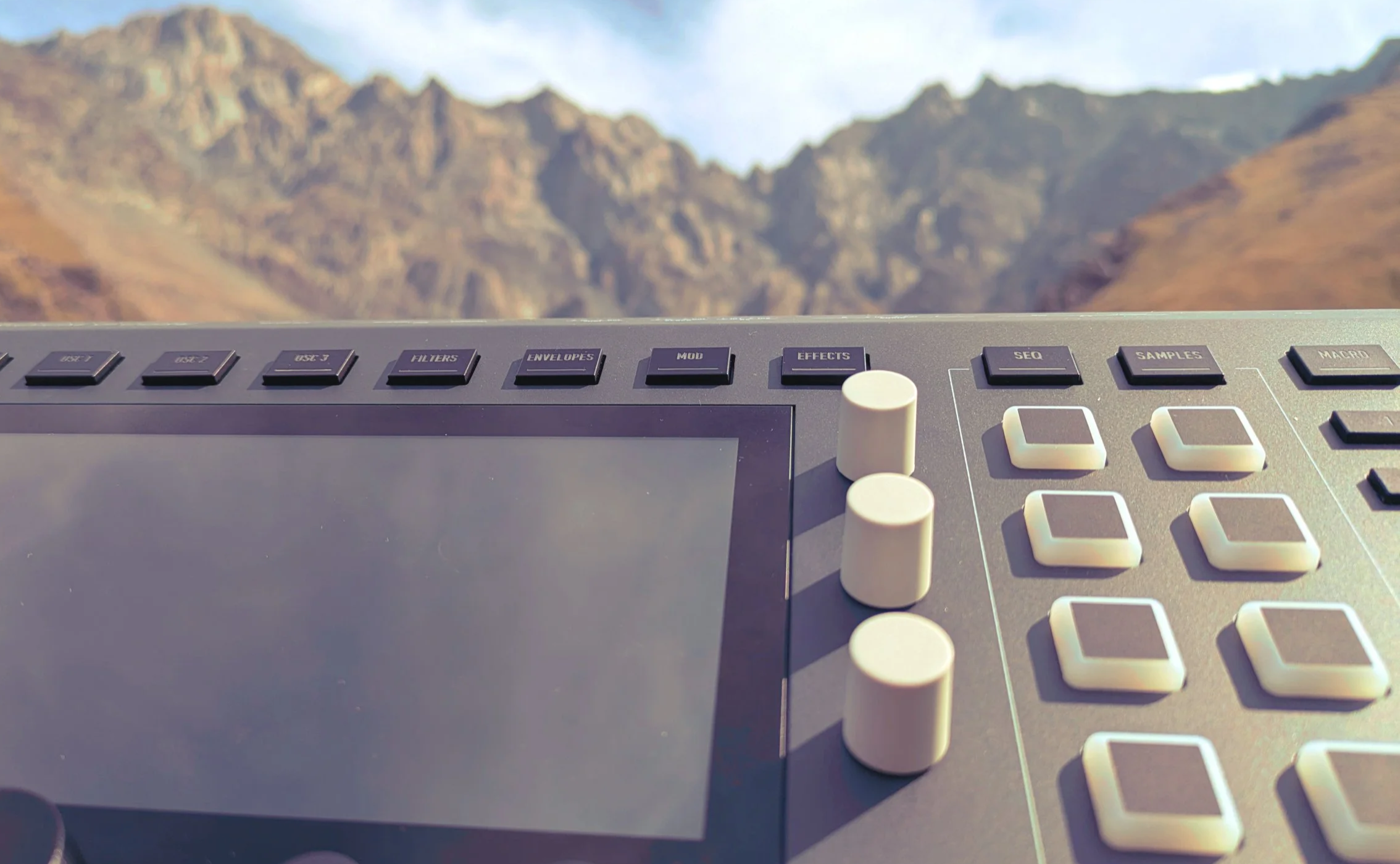
OSCILLATORS
Naturally, the first place to start is with the tone generators themselves. And what can we say here?
The Wavetables are Waldorf’s bread and butter, and all the wavetables from the Blofeld (and presumably the PPG Wave) are here, with even more and more complex modulation capabilities and controls than ever. This is also the only section where the oscillators have a dedicated Brilliance control to amp up the high frequency content without needing to use an EQ. The 3D style view it defaults to when you boot it up is pretty cool, and it’s hypnotic to scan through the waves. There’s certainly a lot of magic to be had in here, especially with a touch of Unison, Chorus, Phaser, Delay, and generous amounts of Shimmer reverb.
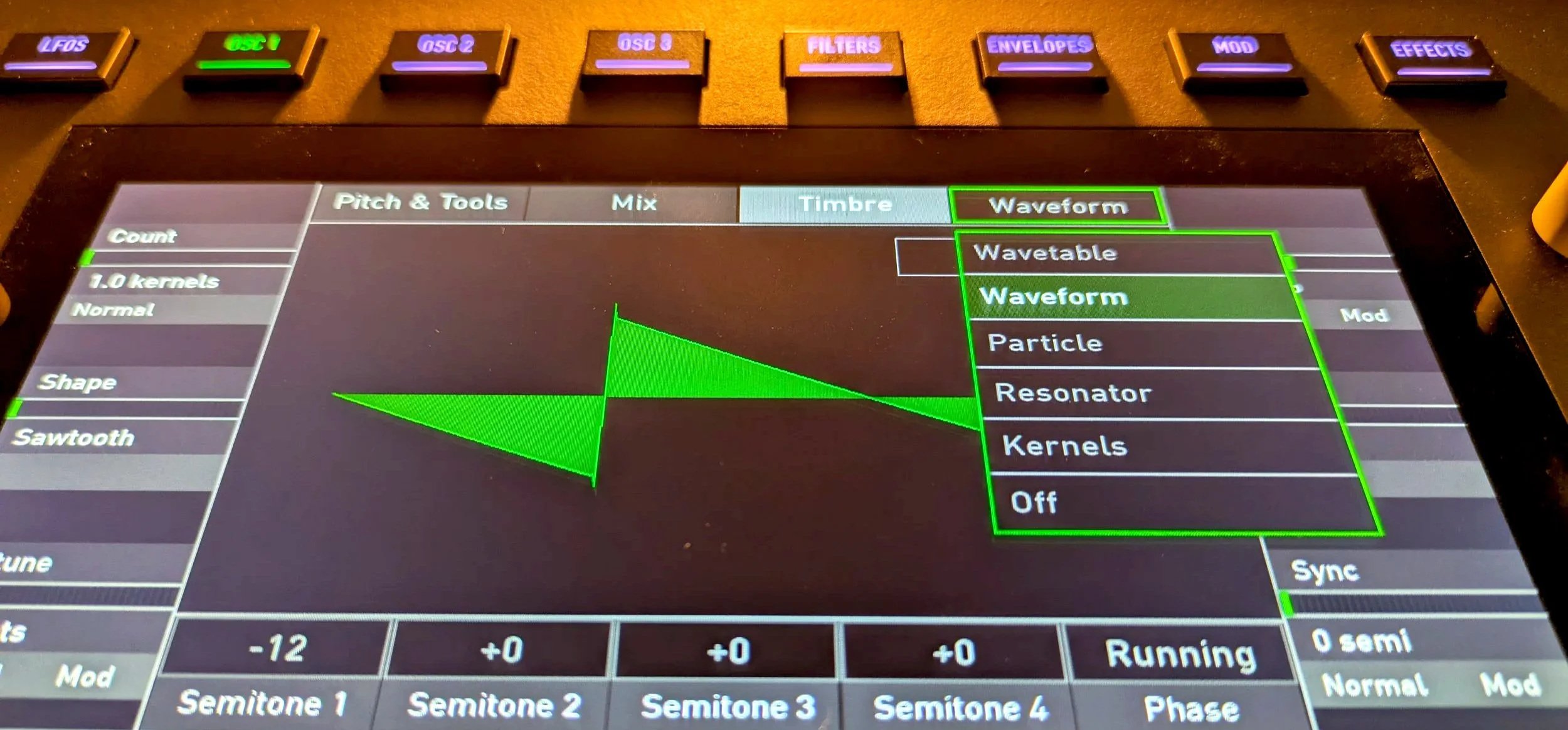
The Waveforms section is our real bread and butter, as most genres of music we make sounds for lean on analog and VA waveforms. Your standard Sawtooth, Triangle, Sine, Pulse, are all there, with Warp controls for added wave sculpting, and there are also extended waves like White Noise, Pink Noise, Geiger, and others.
What’s super nice about the Iridium Core’s Waveforms is the Kernels feature on each oscillator. They describe it as up to 8 sub oscillators applied to each etc etc, but really, what that means is that it allows you to Super- whatever oscillator you’re using. SuperSaw? Yup. SuperSine? Yep. SuperSquare? You betcha. All the analog waves can be Supered. You can detune with any degree of granularity you want to go for nasally to Hardstyle screech. And there are Stereo controls that allow you to spread each of those kernels across the stereo field to achieve unison pan spread-like width, without sacrificing the polyphony to do it. Personally, we avoid using it and still use Unison or the Pan controls in the Mixer section, because the Stereo control on the individual oscillators spreads the notes apart and un-detunes the sounds, so if you want big majestic SuperSaws for a pad or lead, you lose the detuned lush sound as the tones spread across the stereo field and stop interacting closely with one-another’s harmonics. So we still use a couple different tricks to keep sounds epic and wide. In general, we find the actual timbre of the Waveforms to be a little like a Nord Lead 2X, or even a Prophet Rev2 at times. Which, if you know us and how much we love those synths, it’s not a bad comparison. The sound feels a bit thicker than the Blofeld, which may be a product of the filters rather than the oscillators, but we’re sure the source tones from the oscs play a part in the thicker sound. SuperSaw type sounds on the Iridium Core also come convincingly close to the JP-8080, and with a couple small EQ and FX tweaks, you could make sounds basically indistinguishable from an original JP.
There’s also a PitchVar feature hidden in the Pitch section of the Oscillators you can play around with to get varying amounts of random pitch drift, which is great for nailing proper classic analog sounds (alongside an EnvelopeVar, which will be mentioned later).
After that section, we start wandering out into strange and unexplored territory. The Particles mashes together granular and sample-playback synthesis, and frankly we’ve never used those features on anything except partially on Omnisphere, and we haven’t yet encountered a practical use for it for the kinds of sounds we make. That’s not to say we won’t ever. But we just haven’t yet. We do anticipate interesting uses of it in future banks though.
The Resonator is also a trip. We’ve tinkered around a bit with it, and it seems like an interesting way to generate crazy metallic and glassy sounds. Since it seems to operate off playing bandpass filters off each other while being affected by samples and noise, it sounds like the perfect section to create extra weird noises for dark psytrance. And maybe certain kinds of FM-style basses for Slap House or 80’s nostalgia tones.
Kernels is the final and 3rd most familiar kind of synthesis most folks will know. That’s the Iridium’s take on FM Synthesis, and predictably, that section is complex, and not a little opaque. There are a number of presets buried in that menu zone that spit out various bell and clang and glass tones, and in our tweaking with it, we almost managed to nail some of those dirty FM sounds that would work really nicely in dark psytrance and as midrange arp-basses for uplifting trance. It’s not as easy to mess around with as FM is on the Blofeld, but it looks like experimentation (and reading the manual) will reward the adventurous in there.
Overall, this synth offers an almost overwhelming amount of synthesis options, and feels a lot like a Hardware Omnisphere. The only downside in here is that the Noise generators are lumped in with everything else rather than living in their own space as independent generators (like in the case of the Blofeld, Virus C/TI and Mininova), so you have to sacrifice an oscillator to use Noise, which is a bit of a bummer. It’s not a dealbreaker (the same situation applies on the Nord Leads and JD-08 and JP-8080 as well), but just a bit of a bummer.
FILTERS

This is one of the more interesting of the Core’s features. It has the same dual-filter architecture with different filter slopes and styles to choose from as its Blofeld ancestor (Lopass, Hipass, Bandpass, etc), but there are notably more options to choose from as far as filter models. SVF is its default filter type, and as can be expected, it has a pretty typical digital filter sound, not unlike the Blofeld.
After that, we start getting into interesting territory. Raiser sounds like Waldorf’s answer to Moog’s famous Ladder filter, and while I’m not sure it behaves or sounds exactly like a vintage analog Ladder filter, it does sound nice on the 24 dB slope. It doesn’t sound entirely analog, but it is nice.
After that there are Largo and Nave style filters, which I’m not the biggest fan of. I designed a bank of patches for Largo, and was not as fond of its filter as the Blofeld’s.
Where things get cool is with the PPG filter model. That actually sounds the most analog of the filters on the unit, and it does some really nice round and juicy bass and pluck and acid sounds, especially when selecting the Sat or Dirty 24dB filter types. I found myself using this one a lot when designing bass and other patches that I needed to sound more “analog”, because it was the most convincing digital emulation of an analog filter I’ve heard outside the Virus line.
And the addition of the Quantum filter model is a nice addition. I haven’t had a chance to get my hands on a Quantum to A/B test the analog filter in person, but I suspect that the real thing sounds a bit richer than this emulation. But having said that, including it here is super helpful, as it means I can design analog style pads and plucks and basses on the Core, and a Quantum user can load them straight in and have the sounds come out the other side of their true analog filters sounding really nice and proper, without having to manually tweak parameters or swap filter models to get them working right (an issue one of our devs has encountered porting 4-pole Lopass Filter sounds from the Virus TI2 down to work on the Virus B)
If your aim is chasing vintage analog tones with vintage analog filters, the PPG filter really wins the day here.
Bear in mind, if you want to use a Comb Filter, it doesn’t live in the Filter Type or Model menus. The Comb filter has been relegated to the Digi Former menu, which we found slightly annoying, as we like doing things like combining rate reducer effects with comb filters to create trippy psychedelic textures for Dark Psytrance and Ambient soundscape patches.
Now is actually a good time to discuss the Digi Former section in a bit more detail.
It basically acts like a filter-level effect section, mostly devoted to Drive/Distortion effects, rate/ bit rates, comb filters, and other modifiers. You can set the effects to affect the sound before and after the filter, to change the intensity of it, which is nice. On the Blofeld the effect always affected the sound after the filter, so subtlety was hard to achieve except at very low amount settings. So you can add gentle tube saturation to sounds on the Iridium Core the same way you could on the Blofeld, but even more gently.
The Bit Crusher is super nice, and is a lot of fun to mix and match different Bit and Rate amounts, to create super grainy and crunchy noises. One feature we would really like to see in a future update on the Iridium Core though, is a Mix control for the Rate/ Bit Reducer on the Digi Former. Or have the whole effect shifted around to become a dedicated effect in the FX section. It sounds really nice, but having its volume on a sound sitting at one level, makes it hard to create subtle grains and crunch to sounds. The Level control in the Digi Former parameter affects the entire patch’s level, which is inconvenient when trying to add subtle talking rate movement to a bass patch. Your choices are either super loud and overwhelming grit, or so subtle you can’t hear the grains of the sample rate reduction. At least the available parameters of the effect can be modulated in the Mod Matrix, so you can do rate-reduced talking sounds, which is a feature we sorely wished for on the Blofeld. That is super nice.
Another feature that would be cool to see would be an 18 dB/ 3-pole filter, especially on the analog model filters, for achieving more classic 303 style Acid sounds. The original TB-303 had an 18 dB 3-pole filter, and the Mininova and Virus TI2 have it, and it makes it easier to create really classic Acid sounds on those.
It’s still totally possible to make killer Acid sounds on the Core, don’t get us wrong. We made plenty of them. We just know the really authentic sound would be even easier to replicate on a 3-pole filter, which would be awesome to see here.
The dual filter behavior is a lot of fun to experiment with, and we used the dual filter on the Virus TI2 to roughly emulate analog lopass filter sounds on it with the standard lopass, and we also tinkered around with the same idea here with the Core, since it’s also pretty easy to dial in the balance of the filters. Having 2 independent filters is definitely a must for all Ambient and Psytrance and Dub Techno producers, and if creating hazy morphing chord sweeps with tons of movement across mixed hipass and lopass/bandpass filters with lots of reverb and delay and phaser is your thing, you will not be left wanting, here.
ENVELOPES
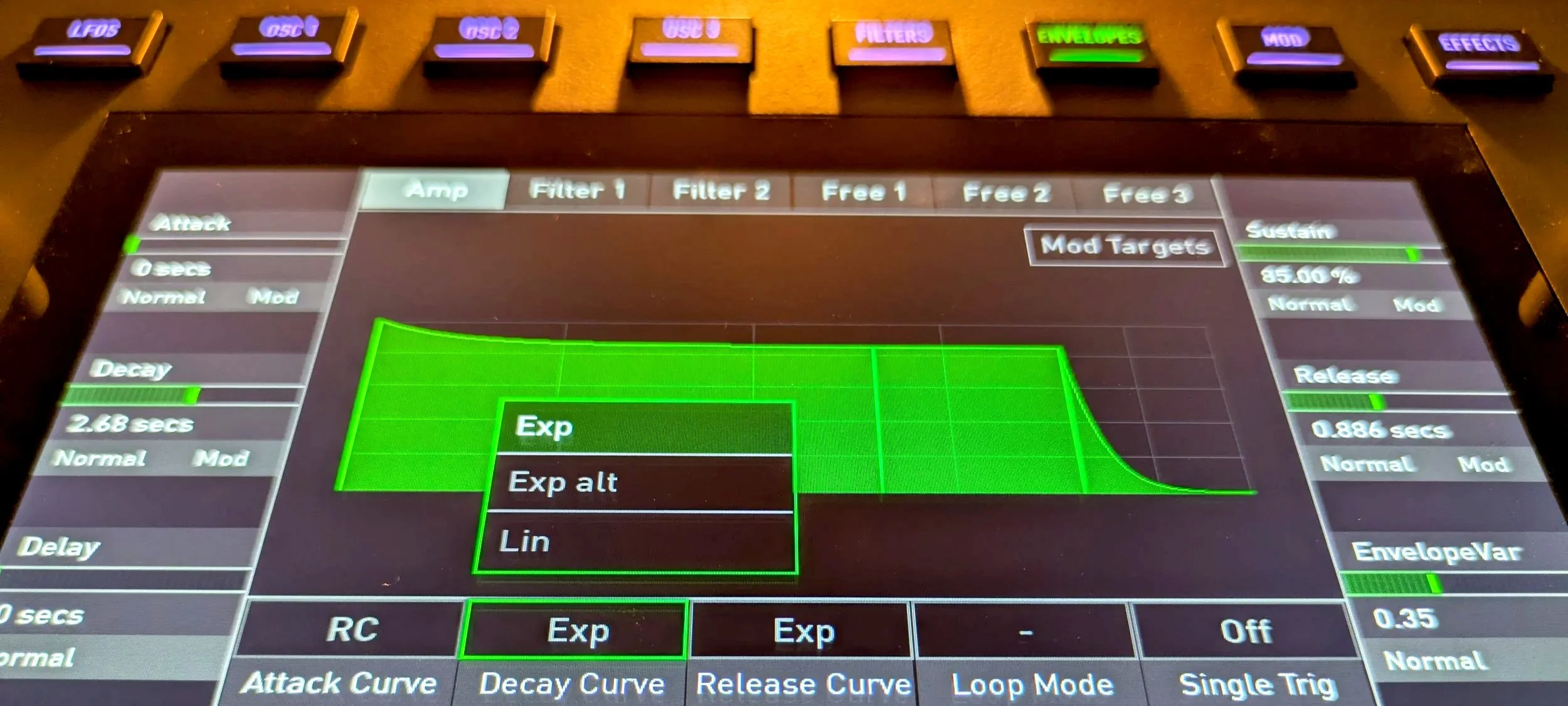
This is another very interesting section for us. On most synths we’ve worked on, the Attack, Decay, and Release curves are what they are, and whatever their default slopes are, that’s what you get. With the Iridium Core here, you can’t fully tweak the curves to custom slopes, but you can switch between very straight digital linear curves, and a couple exponential curve modes that mimic different analog and VA envelope slopes. And for making analog-style plucks and leads, and pads with long tails, having all those options available is really nice.
The EnvelopeVar feature is also cool, although can be a bit weird to work with if you don’t expect it. Along with PitchVar that lurks in the Oscillator Pitch menus, it randomizes parts of the Envelope slopes by whatever amount you set, to mimic vintage analog synth VCA/VCF envelope behavior. If you’re after pure digital envelope precision for genres like Trance or Dubstep, you’ll want to dial this feature down or turn it off, as it can mess around with note consistency in plucks and short lead sounds.
But overall, this is a huge improvement over the Blofeld’s filters, and the only other synth I can think of with even close to this kind of depth of control over filter slopes and such is the Virus TI2 with its Sustain Slope modifiers buried in the Envelope submenus.
The Iridium Core is definitely a synth where you can make this thing’s envelopes sound as analog or digital as you want.
LFO
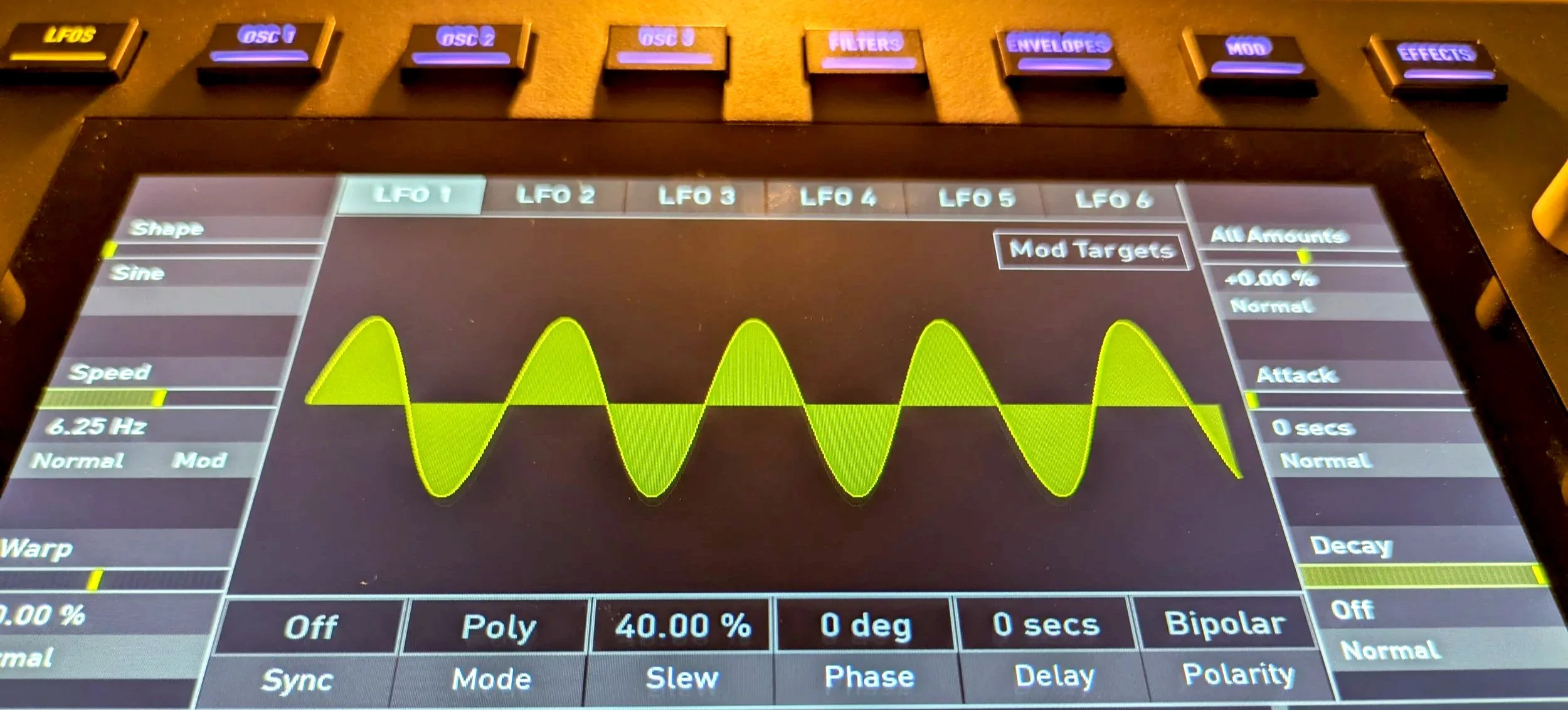
The LFOs on the Iridium line… are wild. Call us crazy but 6 LFOs almost seems like overkill. But we pulled an Ambient soundbank out of a Slim Phatty, so, take that for what you will. Anyway, the LFO section isn’t too out of the ordinary, especially for users of the Waldorf Blofeld or Novation Mininova. Slew, Phase, Delay, and other such features are on both, and are present here.
At first, we were annoyed at the lack of a Random LFO waveshape, until we discovered the Rand and Rand Bipolar Mod Sources in the Mod Matrix. We kind of miss the Random LFO, because you could adjust the “speed” of the random lfo cycles, but random is random, so whatever works. Besides that, the LFOs work just fine and are plenty tweakable for all kinds of modulations.
MODULATION
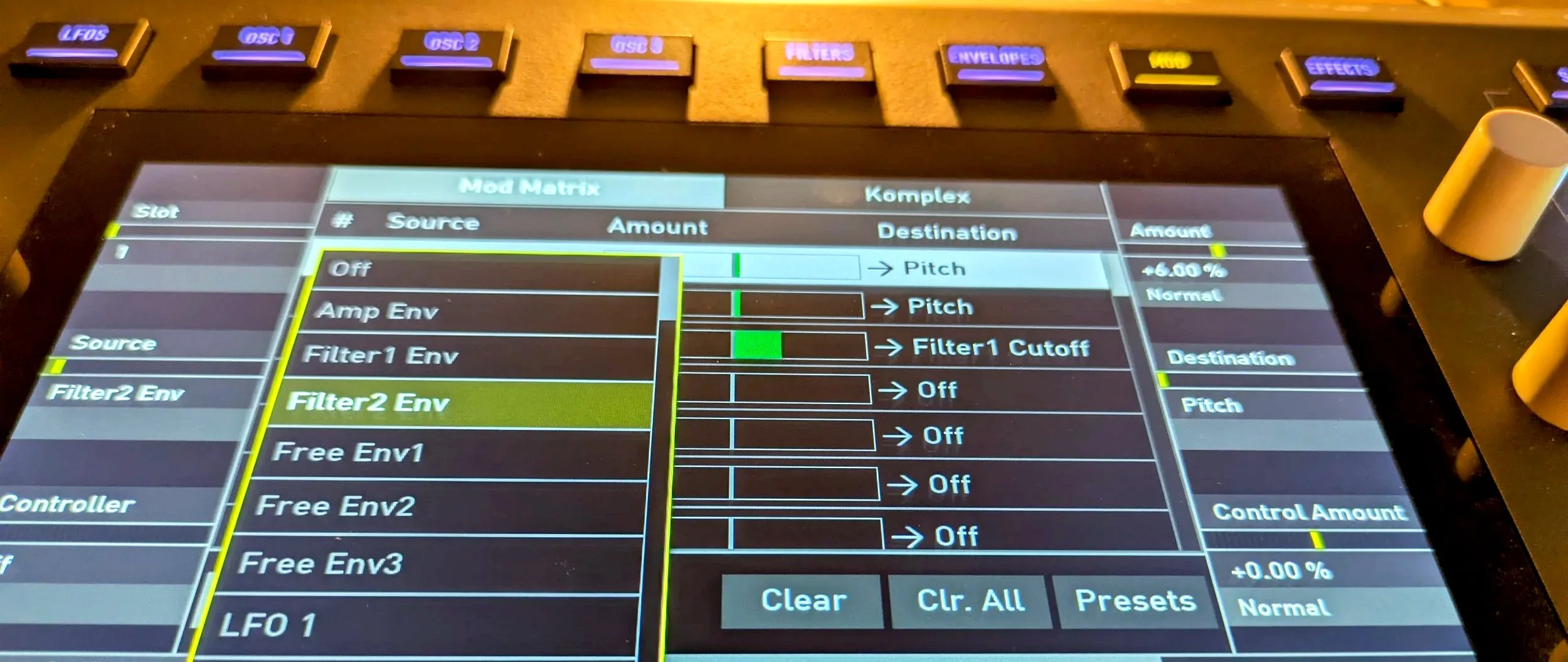
Onward we go to the Mod Matrix. This has always been one of Waldorf’s strengths, and the Mod capabilities of the Iridium Core are flawless. Just about everything can be a destination, and the bonus Controller function eliminates the need to use other mod slots to set up parameter mod chains.
The Komplexer is also quite interesting, and we had a fun time working at setting up Trancegate sequences in it for gated pads. We haven’t quite worked it out completely yet and gotten it to yield the results we want, but we’re going to continue experimenting with it in the future. This synth is a soundseeker’s dream.
EFFECTS
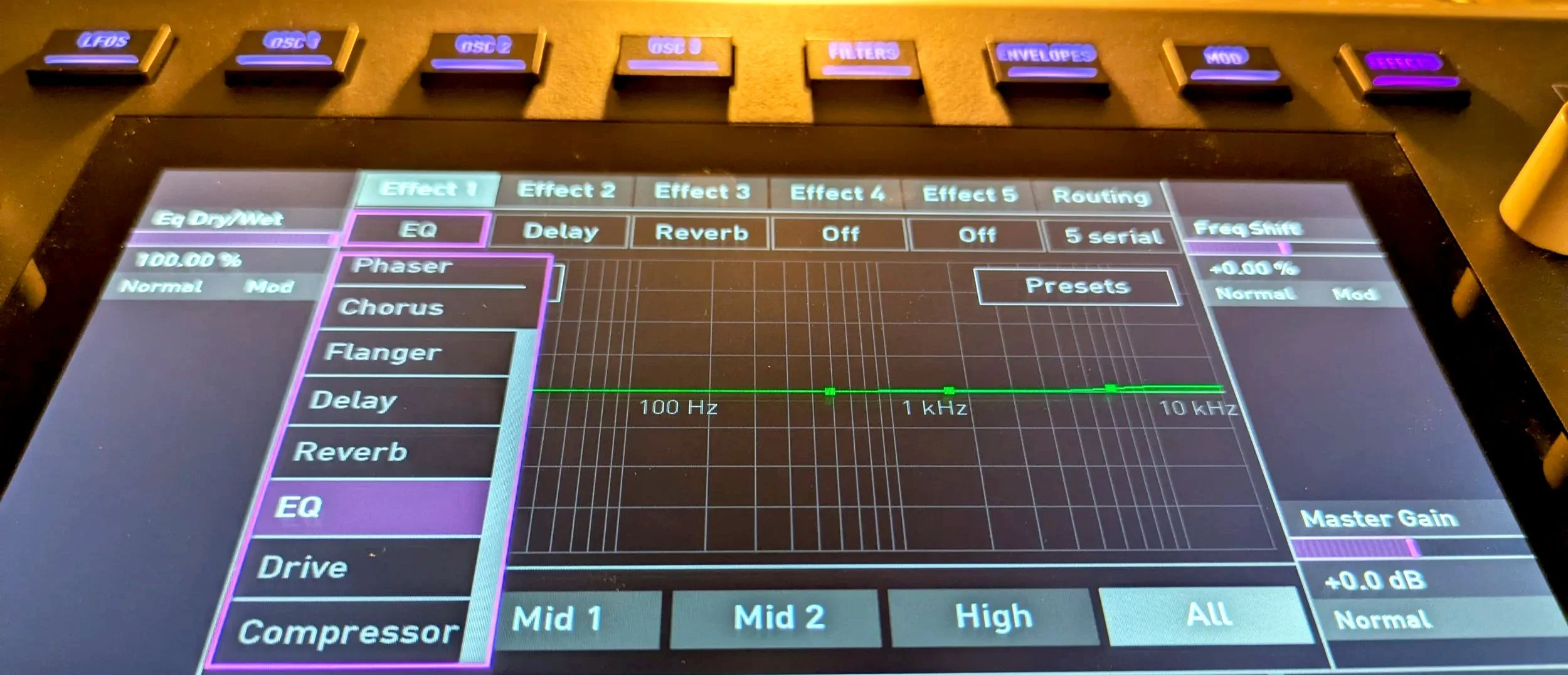
No doubt a fair few of you remember the Blofeld and its… lackluster reverb and phaser.
This is not the case here.
Waldorf completely overhauled all the FX, and these are world-class effects under the hood on the Iridium line now.
The EQ section is super helpful for tweaking the finer bands of sounds, the phaser finally sounds like a phaser and is about at-par with the legendary Virus Phaser, and the Chorus is substantially improved over the Blofeld. We had a tricky time trying to make it sound like a classic JP-8080 or Virus Chorus, but we’ve gotten pretty close results, and we’ll get closer the deeper into this machine we get.
The Delay finally sounds nice and full, and has lots of tone-tweaking controls to help it stay clean in a mix. Hopefully someday they add a Tape Delay setting in there, to facilitate some of those classic delay behaviors that makes Dub techno and Ambient so fun to experiment around with.
Flanger is also a nice touch, and is great for trippy Psytrance sounds and effects.
The Drive/ Distortion section is also nice (although we’d be lying if we didn’t admit we miss some of the old Blofeld distortion algorithms. The Blofeld could get mean and make some truly aggressive Dubstep and Industrial sounds with its distortion effects.
We must confess we are not the biggest experts at wrangling Compressors, and our own efforts at messing around with it in here had mixed results, so we’re not the best judge of how the Compressor in here is.
But we all know what you really want to know, is if the Reverb is any good.
And the answer is a solid resounding YES.
It can sound as massive and spacious, or as tight and confined as you want, and it has all kinds of mod and color controls to make it bright and airy or dark and lush, in any degree. And that’s just the standard reverb. As of October 20 2026, a new beta OS update for the Iridium Core gave it an additional Shimmer Reverb setting, which we have only barely scratched the surface of, but were extremely impressed in our early tests. The pitch warbles and creates spectacular Hans Zimmeresque cinematic tones that sends even the most basic synth plucks soaring off into the orbits of distant black holes. The regular and shimmer reverbs are going to be very hard not to abuse and overuse on soundbanks going forward. They just sound too frickin’ good. Definite Virus Competitor, these.
CONCLUSION
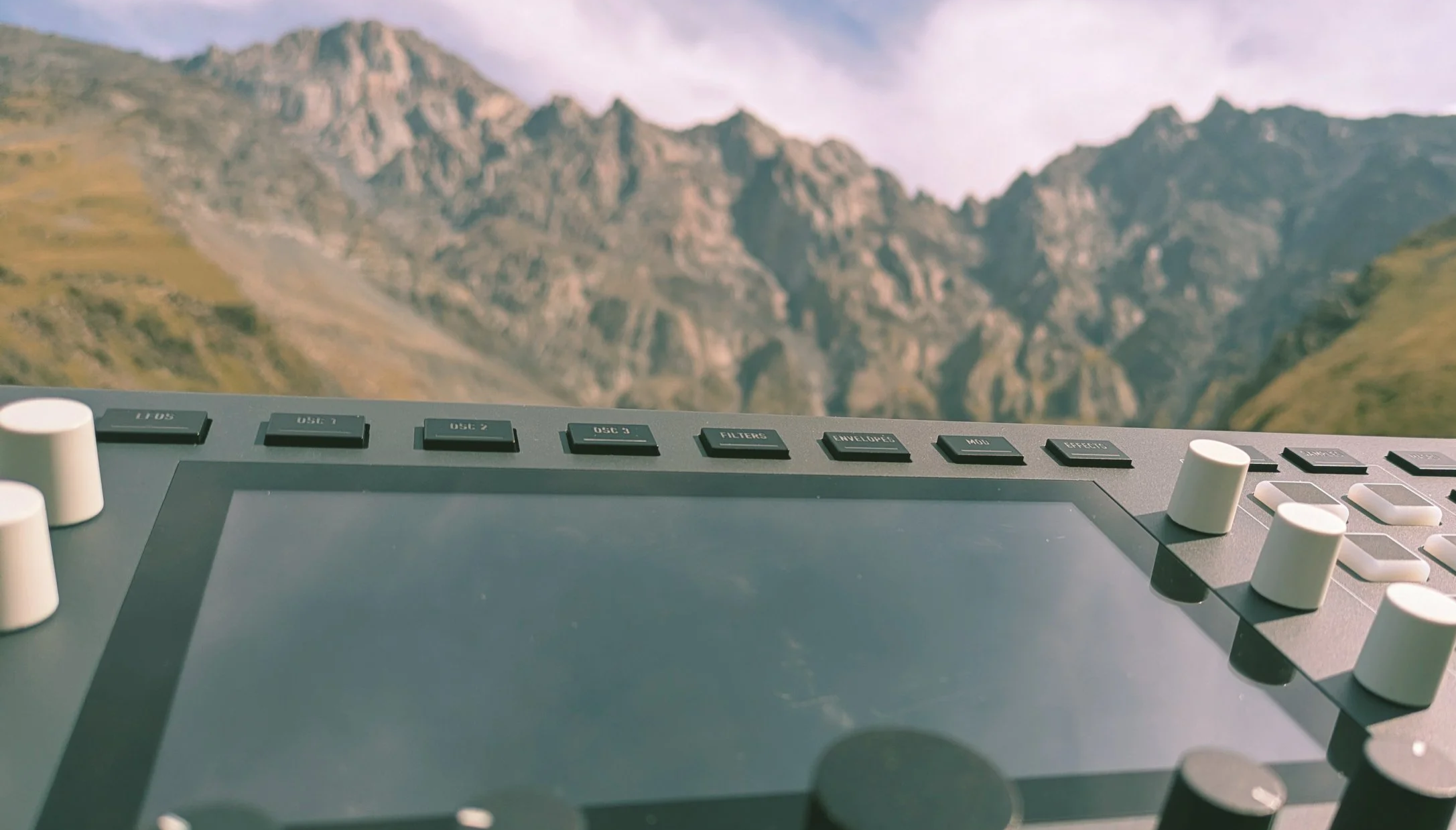
So, here at the end of it all, the question remains: Is an Iridium Core worthit? Do the features justify the price?
Thus far, we would have to say, yes.
In a world where thee Access Virus TI2 and Waldorf Q and Supernova II Pro X are long out of production and the Blofeld just ceased production, there is definitely a place in the market for a multi-engine VA/Wavetable/Sample-Processor synth with absurdly deep mod capabilities. Too many synths out there (in our opinion) are being released with either too small a featureset, or too few voices, and even at 12 stock voices, the Iridium Core punches above many other current synths on the market. The build quality of the Iridium Core is sturdy and the funky falling screen issues of past Iridiums and Quantums seems to have been resolved.
We scored our Iridium Core for less than our Prophet Rev2, and in that regard were exceptionally fortunate. But having said that, part of what makes the Iridium MK 1 and 2 so expensive are the knobs and extended new features (obviously).
And being long-time users of the Blofeld, working on minimalist interfaces doesn’t scare us. The Iridium Core is even more intuitive than the Blofeld, and the Blofeld wasn’t too hard for us. And the smaller featureset/ polyphony of the Iridium Core is, as of October 2026, is not the issue it was when the Core first dropped several years ago.
Back in September, Waldorf release the 4.1.0 beta OS update that increased the polyphony from 12 to 16, which we’re sure is a simple software change adding 4 extra dynamic voices that may or may not disappear under heavy DSP loads. But for most of what we do, that’s not going to be a problem. So we paid for a 12 voice synth, and got a 16 voice synth.
And thanks to these frequent and not-inconsequential OS updates, we’re being treated to all kinds of new effects and fixes that are rapidly making the Core close the gap with the Virus TI2. The practical utility of this synth is increasing for free just about every month, and that effectively makes it a synth worth its sticker price, and then some.
We’ve coaxed all kinds of superb sounds out of this machine in the relatively short time we’ve had it, and by the time you read this we will have made even more.
So if you’re a dance or ambient producer looking for a new hardware synth that will rock hard at the genres you make, and won’t suddenly die on you due to obsolete part failure because it’s 30 years old, the Waldorf Iridium Core is an excellent choice that is well worth the money (especially as time goes on and more updates and fixes add features and iron out kinks).
101 uplifting Trance presets, compatible with the Waldorf Iridium, Iridium Core, and Quantum hardware synthesizer series. This soundbank is 100% Trance-oriented and comes packed with euphoric leads, majestic pads, thundering basses, epic plucks, and screaming 303 acid patches, with no filler sounds. The patches in Arete come straight out of songs written using the legendary Waldorf Q, XT, microQ, Blofeld, and Pulse synths. Designed to fully exploit the Iridium’s advanced virtual analog engine, complex wavetables, deep mod matrix, and dual multi-mode filters, this soundset pushes the Iridium and Quantum to their fullest potential!
Patches in Arete are based on sounds from songs by the likes of Rank 1, Pulser, Driftmoon, Armin van Buuren, Ferry Tayle, 7 Skies, DuMonde, Arctic Moon, Wavetraxx, Aly & Fila, Tom Porcell, Giuseppe Ottaviani, Roger Shah, Ferry Corsten, Ralph Novell, Basis 1, Gaia, Alphazone, Aimoon, The Mystery, Dawnchaser, Denga & Manus, The Thrillseekers, Airbase, BT, Manian, Ace Da Brain, Akira Kayosa, Ron van den Beuken, Scooter, DJ Scot Project, Vengeance, Marcel Woods, Ruff Stuff, K-System, Mike Shiver, Phalanx, and many many more!
No additional FX were applied to these sounds post-recording
Many sounds use the Modwheel for added control
Sounds in this preset pack are suitable for the Uplifting Trance, Hard Trance, Tech Trance, Progressive Trance, and Classic Trance genres, and are organized by category into Leads, Plucks, Pads, Acid sounds, and Basses, for quick reference
All patches are royalty-free and delivered instantly via email as a 24-hour download link
Requirements: Waldorf Iridium synthesizer
Also compatible with Waldorf Iridium Core and Waldorf Quantum Series
“This bank makes full use of the Iridium’s powerful VA and wavetable engines and those superb filters that make it stand out from the crowd.” - Rob Puricelli, GearNews