Do Analog Synths Belong In Trance Music?
When folks jump on Facebook or Reddit to ask about the best synths to use for Trance, it often seems like there’s only 3 or 4 names that ever come up. Spire. Sylenth1. Virus TI (or OsTIrus, now). JP-8000 (or JE-8086, as of December 2025). The occasional mention of Diva. Lots of digital polyphonic VST plugins with some version of a SuperSaw baked into the architecture somewhere in the signal path.
And following that same thread, an almost equal number of Trance fans (especially the older ones) complain that everything sounds the same, and the life has gone out of modern Trance. While I fundamentally disagree with that premise, I do think there is something to the idea that Sameness has taken over the sound. Some folks would say the genre has become trapped in its own tropes and experimentation and deviation from the standard SuperSaws & Arpeggios ends in apathy or punishment from the scene, but I also don’t agree with that premise.
A lot of great tunes from the 90s on to the mid-2010s did not use those sounds, or they weren’t the primary focus, and those sounds had a lot of character.
And with the massive explosion in interest of analog synths that has happened since the 2010s, I think now is the perfect time for Trance artists to veer away from the typical SuperSaw sound, and start incorporating a little analog character and unpredictability into their mixes.
It’s true that most Trance producers avoid Analog synths. Many are monophonic, and the ones that aren’t, tend to be expensive, and have limited polyphony compared to their plugin cousins.
But there are still many places where Analog synths can serve useful secondary, and even central roles in big Trance anthems.
Where Analog Fits In The Mix
The most obvious example is what most folks associate Analog synths with… bassline duties. And Analog is great for basslines. Sometimes too great.
Take for example, these 2 songs. On Heaven, Wavetraxx and I used the Prophet Rev2 for a midrange bass layer, to add extra character to the low end. The rest of the song is digital, but DCO Analog sound still occupies a supporting role in the mix, and lends the character extra depth. The bass sound didn’t get used for the entire sub + midrange layer because the saturation baked into the sound was too heavy for the mix, and without lopassing to cut the lows and some lo-mids out of the sound, it would have clashed with the kick. But hipassed and notched tastefully, it sat tidily on top of the sub bass, and added an extra dimension to the music that makes it feel more organic.
Midrange Bass: Sequential Prophet Rev2
And below in Cascade Highway, the Prophet Rev2 is fully on bassline duties, in both the sub bass and the midrange bass. I used the Virus TI2’s Rate Reducer FX to give the midbass a kind of ‘talking’ evolving character. But the weight and punchiness of the DCO Analog sound in the lows (with added Osc Slop to the oscillator tuning to add classic analog behavior flavor) gives the tune a round warm character. And the nice part of the Prophet is its Panning capabilities, making it possible to create bouncing midrange basses that widen the song without needing any special technical tricks.
Sub Bass & Midrange Bass: Sequential Prophet Rev2
Lead The WaY
But for less obvious uses, Analog synths work great for Trance Leads. As you can hear in the playlist below, most of the synths use some forms of Pulse and Sawtooth waves, with some added FX to liven them up. Except for Empire of Hearts, every other song uses sounds that can easily be made on any analog synth with 1-2 LFOs and some basic Pulse Width and Pitch modulation capabilities (which is basically all of them). The Empire of Hearts lead could be made on any analog synth with 3 or more voices, and anything with a sub oscillator alongside 2 regular oscillators. The songs in the demos (we think, anyway) mostly use VA synths like the Virus, or Supernova or Q. But the waves the sounds are based on can be found on everything from a classic Minimoog to a Sequential Fourm or OB-6.
Indeed, modern analogs like the Prophet Rev2, Teo-5, Fourm, OB-6, and OB-X8 can even do quasi-SuperSaws, with the Teo-5 and Fourm sounding the best of the bunch (according to our Superbooth 2026 live tests). You can make digital-style sounds on Analog synths very capably, and in the case of the Teo-5, sound even better than the original sound you were trying to mimic.
More Than Meets The Ear
There is a lot of underutilized Trance potential in the many Moog, Sequential, Oberheim, Korg, Arturia, Behringer, and countless boutique Analog synths made by smaller companies, just waiting to be tapped into. With little more than a couple octave-spread square waves, a fast LFO on the pitch at a low setting, and a touch of white noise, you can make a buzzy biting lead synth straight out of late 2000s epic and progressive trance that would cut through any modern mix and add a certain je ne sais quoi to your music that listeners may not know is specifically analog, but will recognize as unique and pleasing, and subtly set you apart from everyone else.
Get Plucky
The same logic applies to plucks as well. Mono synths can be tricky for plucks, but if you’re willing to write riffs that are not just racing 16th note arpeggios with the notes all clustered together, or big stacked chords, you can make an analog mono synth sound every bit as big and majestic in a mix as any Virus or Diva pluck. And small touches like pitch drift, or analog filter variations in VCO synths lend a more organic quality to the sound that will feel more natural, without the need to apply special settings in a plugin to achieve it. And with Moogs, their baked-in low-mid saturation makes upper register plucks sound super round and rich.
Opening pluck: PL Skylark (from Skylarking by BT)
Although Analog poly synths sound very rich for plucks too. The Prophets all have their own individual character, and because they’re all polyphonic to different degrees, you can play some super nice epic chords with them. Some synths lend themselves better to warmer gentler sounds, others to brighter snappier sounds, but synths like the Rev2 can handle both very nicely (although it tends more toward bright by default).
Pluck: PL Everytime (from Everytime You Need Me by Fragma ft Maria Rubia)
And because every synth manufacturer uses different parts for their gear, sometimes even different parts between different synths in their inventory, even things as basic as Square and Saw waves don’t sound alike between instruments.
The timbral differences between different Moogs
So if every producer is using different instruments, be they budget or flagship, they will all sound subtly different from one another, and Trance will gradually begin to regain its lost feeling of variety. There have been a growing number of artists doing this, Giuseppe Ottaviani being one of the most notable examples, and it shows in his music. Arguments that folks can’t hear the difference in a mix are missing the point. It’s not that they’re hearing Analog specifically. What they’re hearing are variations in tone, timbre, and the differences in workflows that guide the production and mixing decisions for each artist, based on their instrument choices. When everyone is using the same easily-pirated VST plugins, everyone starts from the exact same place, and room for variation is narrower.
When everyone starts from different places, even when they’re all making the same genres, they’re all going to sound a little different.
Thanks to companies like Behringer making full on budget gear, Korg making mid-priced synths like the Minilogue and Monologue (and even the oft-ignored Prologue) and companies like Sequential creating entry-level analog poly synths (to say nothing of their older discontinued units like the Mopho and the Tetra), and discontinued Moog synths like the Slim Phatty and Subsequent 25 commanding more reasonable prices than the super expensive new gear on the market, there has never been a better time to explore all the options out there and start incorporating less-conventional synths and synth sounds into Trance.
So, Do Analog Synths Belong In Trance?
Absolutely. Does everyone need the most expensive, feature-loaded piece of flagship kit from the biggest prestige manufacturers? No. Will an Analog synth magically make your music world-class the moment you turn it on? Again, no.
But like with most anything else, if you know what you want your music to sound like, and you understand some basics about sound design and music composition, you can turn even the most basic and cheap analog module into the centerpiece of your next monster Luminosity anthem. It’s like Murderface says in Metalocalypse: “It’s a very dangerous weapon to know what you’re doing”.
And in a world where every Uplifting Trance 2026 Mix sounds like the same 3 Spire SuperSaw presets, we all owe it to our listeners to do something different, even if it’s so subtle they might not notice it immediately. The music world’s homogenized a lot in the last decade. Let’s mix things up a little.
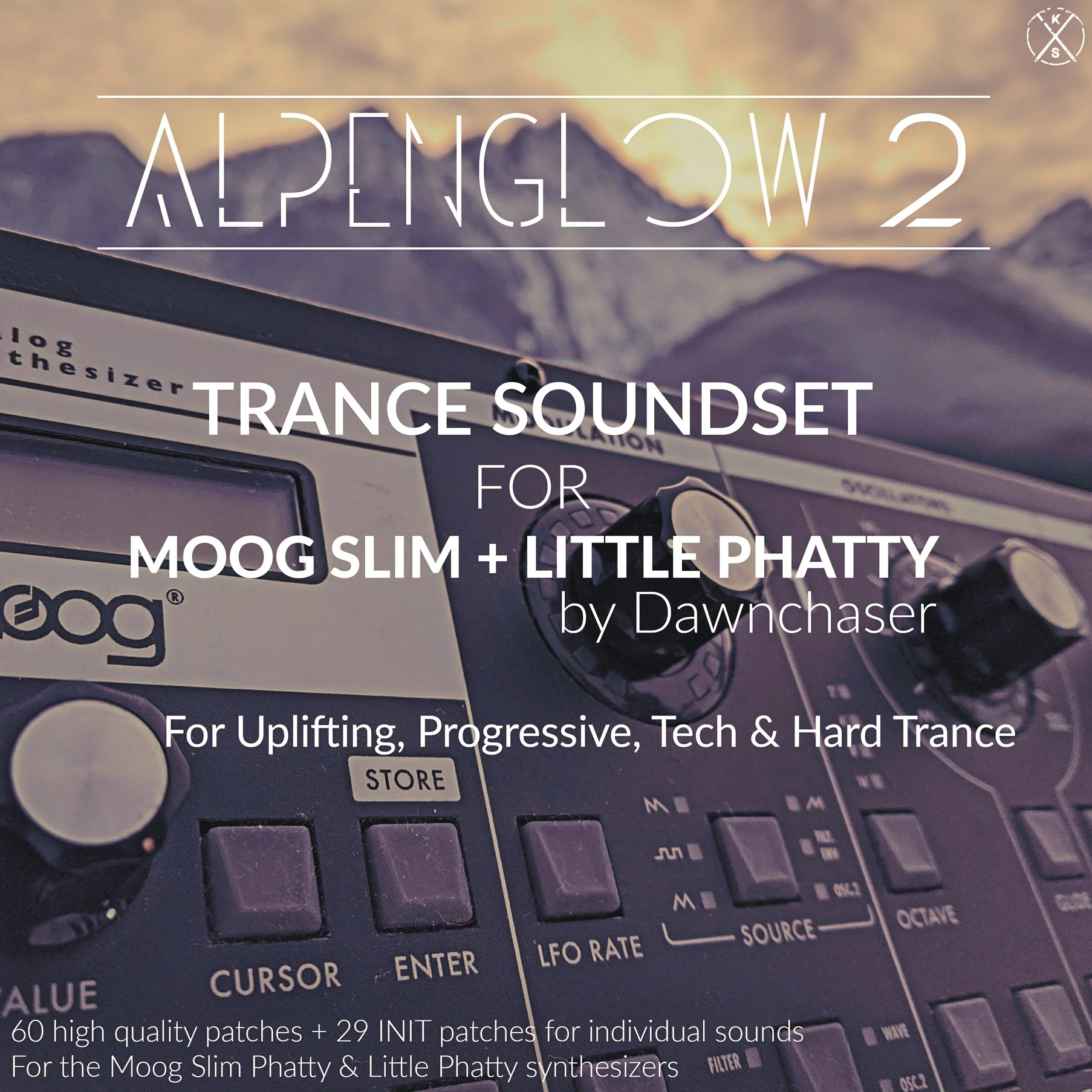


60 uplifting Trance presets, compatible with the Moog Slim and Little Phatty analog hardware synths. This soundbank is 100% Trance-oriented, which means no weird clangs, bleeps, effects, drums, shrieks, or cheesy 70s funk leads. The patches in Alpenglow come straight out of songs by big name artists of the 90s, 2000s, and 2010s. So this soundset is designed to fully exploit the fat Moog ladder filter and overdrive to their max!
Patches in Alpenglow are based on sounds from songs by the likes of Armin van Buuren, Rank 1, ATB, Darude, Ratty, Alphazone, DuMonde, Warp Brothers, Dawnchaser, Orjan Nilsen, Vengeance, Airbase, BT, and many many more!
And to cap off the bank, some patches are set to INIT, so you have room to write and store your own patches without overwriting any existing sounds!
Only FX used on these sounds outside the onboard FX was Virus TI2 reverb and delay on the leads/ plucks (except for the lead Reduce Me, which had a moderate amount of Virus Rate Reducer applied to it).
Sounds in this preset pack are suitable for the Uplifting Trance, Hard Trance, Tech Trance, Progressive Trance, and Classic Trance genres, and are organized by category into Leads, Plucks, Pads, Acid sounds, and Basses, for quick reference
All patches are royalty-free and delivered instantly via email as a 24-hour download link
Requirements: Moog Slim Phatty or Little Phatty synthesizer